2 weeks Sri Lanka itinerary
Sri Lanka is one of those destinations that feels wonderfully complete. In a relatively short distance, you can move from golden beaches to ancient cities, from misty tea-covered mountains to national parks filled with elephants and leopards. It is a country that suits travelers who love variety, because every few hours the landscape changes, the atmosphere shifts, and the journey feels new again. For travelers with more time, this 2 week Sri Lanka itinerary is one of the best ways to experience the island properly. Two weeks gives you the space to travel at a more enjoyable pace, without feeling like you are constantly rushing from one highlight to the next. You can still visit the famous places, but you also have time to slow down, stay longer in beautiful locations, and enjoy the moments in between.
This route is ideal for first-time visitors who want a balanced trip through Sri Lanka’s most iconic regions. It combines culture, wildlife, scenic train travel, mountain villages, and beach time into one logical itinerary. Along the way, you will also find accommodation suggestions for different budgets and carefully chosen tour ideas that can be integrated naturally into the journey. If you are looking for a route that shows the very best of the island while still feeling realistic and inspiring, this 2 week Sri Lanka itinerary is a strong place to start.
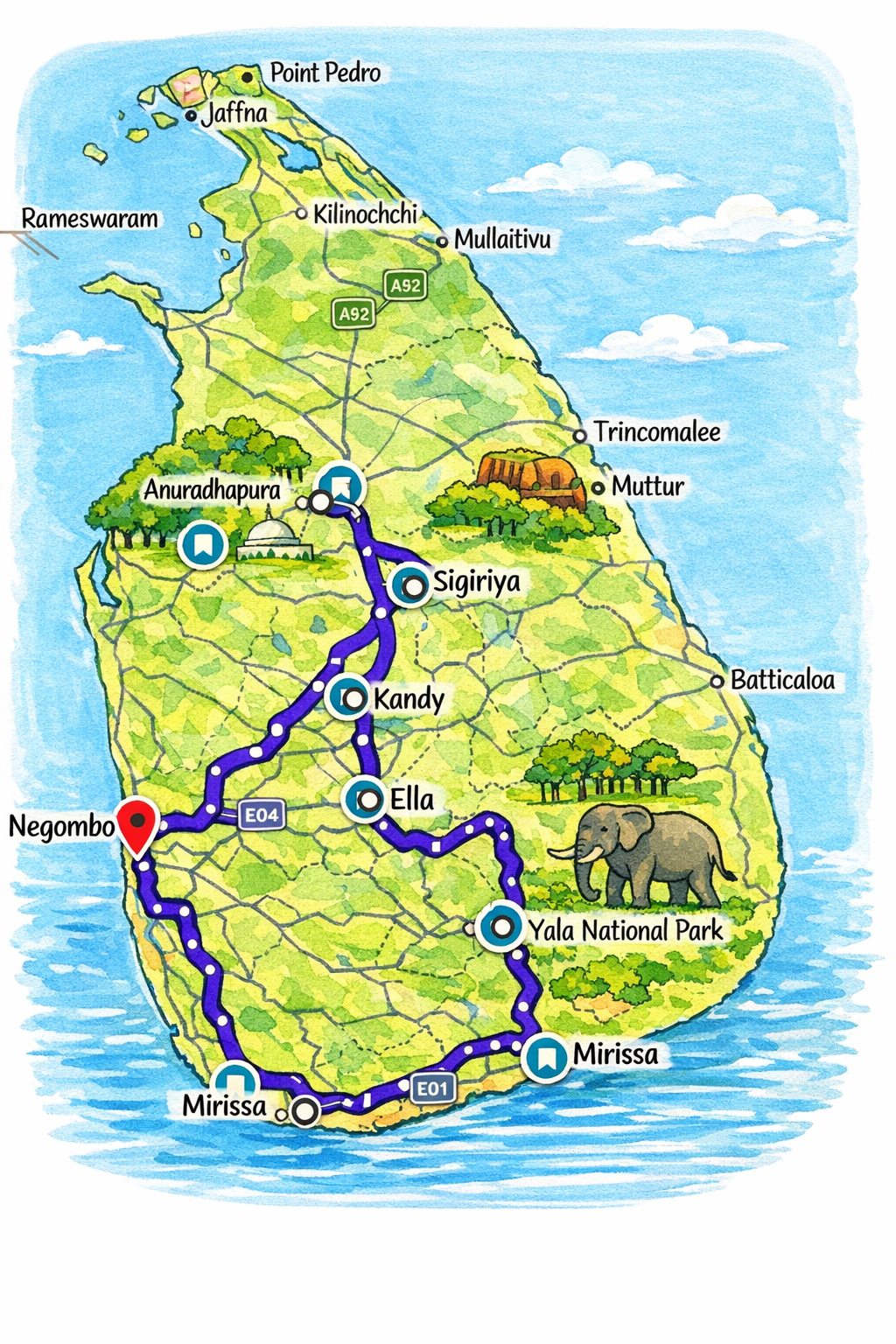
Day 1 – Arrival in Sri Lanka and overnight in Negombo
Day 2 – Negombo to Sigiriya
Day 3 – Exploring Sigiriya and the cultural triangle
Day 4 – Day Trip to Anuradhapura or Polonnaruwa
Day 5 – Sigiriya to Kandy
Day 6 – Kandy to Nuwara Eliya
Day 7 – Nuwara Eliya to Ella by train
Day 8 – Exploring Ella
Day 9 – Ella to Yala National Park
Day 10 – Safari and travel to the South Coast
Day 11 – South Coast beach day
Day 12 – Galle and the Southern Coast
Day 13 – South Coast to Bentota or Colombo
Day 14 – Departure Day
Day 1 – Arrival in Sri Lanka and overnight in Negombo
Most international travelers arrive at Bandaranaike International Airport, just north of Colombo. After a long flight, it is usually far more pleasant to avoid a long transfer straight away and spend your first night in Negombo instead. This laid-back coastal town is only a short drive from the airport and offers an easy introduction to Sri Lanka. Negombo has a different feel from the rest of the island. It is a fishing town with colonial influences, a long beach, and a relaxed atmosphere that makes it perfect for easing into your trip. Depending on your arrival time, you can spend the late afternoon walking along the beach, watching the colorful fishing boats, or enjoying your first Sri Lankan meal with a view of the ocean. The town is not the most beautiful beach destination in the country, but it serves an important purpose: it allows you to rest, reset, and begin the journey without stress.
If you want to do something gentle on your first day, you could visit the Negombo fish market in the late afternoon or take a short boat trip through the nearby lagoon. The lagoon area is particularly peaceful around sunset, when the water reflects the sky and birds skim across the surface. It is a soft beginning to what will become a rich and varied journey.
For a luxurious first night, Jetwing Blue is a popular choice, offering direct beach access, spacious rooms, and a polished resort atmosphere. If you are looking for a comfortable mid-range option, Terrace Green Hotel & Spais stylish, well-located, and ideal for recovering from a long flight. Travelers on a smaller budget often enjoyPledge Scape, which feels modern and intimate without the high price tag.
Day 2 – Negombo to Sigiriya
After breakfast, your real journey begins as you travel inland toward Sigiriya, one of the most famous destinations in Sri Lanka. The drive takes around four to five hours, depending on traffic and stops, but it is a rewarding transfer because it gradually introduces you to the greener, more rural side of the island. As you leave the coast behind, the scenery changes from bustling roads and seaside towns to open countryside, rice fields, roadside fruit stands, and quiet village life. This is part of the beauty of Sri Lanka: the transitions are visible and immediate. Even the journey itself feels like travel in the best sense of the word.
Sigiriya lies in the heart of Sri Lanka’s Cultural Triangle, the region known for its ancient cities, rock fortresses, cave temples, and historic reservoirs. It is one of the best bases in the country because there is so much to see within a relatively short distance. The area feels calm and spacious, with jungle, lakes, and wide-open views creating a completely different mood from the coast. If you arrive with some time left in the afternoon, a wonderful way to settle in is by climbing Pidurangala Rock for sunset. The hike is short but adventurous, and the reward is one of the best views in Sri Lanka: Sigiriya Rock rising dramatically from the surrounding jungle. This is a particularly photogenic moment and one that often becomes a highlight of the trip.
For a luxury stay, Water Garden Sigiriyais one of the most memorable properties in the area, with beautiful villas, elegant landscaping, and views toward the famous rock. A great mid-range choice is Aliya Resort & Spa, known for its spacious rooms and infinity pool facing Sigiriya. Budget travelers often enjoy Sigiriya Village Hotel, which is atmospheric, well-located, and surrounded by tropical greenery.
Day 3 – Exploring Sigiriya and the cultural triangle
Your first full day in the Cultural Triangle should begin early with the climb up Sigiriya Lion Rock. This UNESCO World Heritage Site is one of the defining landmarks of Sri Lanka, and seeing it in person is every bit as impressive as the photographs suggest. Rising almost 200 meters above the plain, the rock once served as the site of a royal palace built by King Kashyapa in the fifth century. The climb is not just about the summit. The experience unfolds in stages. First come the beautifully laid out water gardens and boulder gardens below, then the famous frescoes painted into the rock face, then the mirror wall, and finally the dramatic Lion’s Paw platform that leads to the final staircase. At the top, the remains of the palace still trace the outline of a once-ambitious kingdom, while the views stretch endlessly over the surrounding forest and lakes.
Later in the day, continue to Dambulla Cave Temple, located around thirty minutes away. This temple complex is one of the most atmospheric religious sites in Sri Lanka. Built into a series of caves, it contains hundreds of Buddha statues and richly colored murals covering the ceilings and walls. It feels both grand and intimate, and the soft light inside the caves gives the whole complex a timeless quality. If you want to add a more local experience to the day, you canjoin a village tournear Sigiriya, where travelers are taken through rural farmland by cart or canoe and often end with a home-cooked Sri Lankan meal. When chosen carefully, these tours can be a pleasant way to understand daily life in the countryside.
Spend a second night in Sigiriya, allowing yourself to enjoy the quiet of the region rather than packing up again too quickly.
Day 4 – Day trip to Anuradhapura or Polonnaruwa
One of the advantages of staying multiple nights in Sigiriya is that you can explore more deeply. Today you can choose between two of Sri Lanka’s great ancient cities: Anuradhapura or Polonnaruwa. Both are significant, both are UNESCO sites, and both offer something slightly different. Anuradhapura feels vast, spiritual, and spread out. It was one of the oldest continuously inhabited cities in the world and remains an important pilgrimage site. The white dagobas, sacred Bodhi tree, monastery ruins, and broad processional roads create a sense of scale that is hard to forget. It is a place where history and living devotion still exist side by side.
Polonnaruwa, by contrast, feels more compact and visually accessible. The ruins are easier to explore in a single day and include elegant stone carvings, palace remains, and the famous Gal Vihara, where massive Buddha statues have been carved directly into granite. Many travelers prefer Polonnaruwa because it is more manageable, especially in warm weather, and can easily be explored by bicycle. If you are traveling with a private driver, either destination works well as a day trip from Sigiriya. If you prefer more structure, guided day tours can be a convenient option, especially for those interested in the historical context. Return to Sigiriya in the late afternoon for a final night in the Cultural Triangle.
Day 5 – Sigiriya to Kandy
Today you leave the dry plains of the Cultural Triangle and begin moving toward Sri Lanka’s central highlands. The drive to Kandy takes roughly three hours, depending on stops, and the change in scenery is noticeable. The roads begin to rise, the air feels a little cooler, and the landscapes become greener and more layered. A classic stop on the way is Matale, where many travelers visit a spice garden. Sri Lanka’s long history with spices is central to its identity, and seeing cinnamon, nutmeg, pepper, cloves, and cardamom growing in one place offers a deeper appreciation for local cuisine. Some spice gardens are more commercial than others, so it is worth choosing one with good reviews or visiting through a well-rated driver or guide.
Kandy sits around a peaceful lake and is surrounded by forested hills. It is often described as the cultural capital of Sri Lanka, and it has a very different energy from Colombo or Negombo. There is something gentler and more traditional about the city, especially around the lake and temple area. The highlight here is the Temple of the Sacred Tooth Relic, one of the most important Buddhist temples in the world. The relic housed inside is believed to be one of Buddha’s teeth, and the temple remains an active and deeply revered pilgrimage site. Visiting during the evening ceremony is particularly atmospheric, with drumming, flowers, incense, and a steady stream of worshippers creating a powerful sense of place. If time allows, take a walk around Kandy Lake or visit the Royal Botanical Gardens in Peradeniya, which are known for their enormous collection of tropical plants and one of the most beautiful palm avenues in Asia.
For a luxury stay, The Kandy House is a standout choice, offering colonial character and a calm setting outside the city. A stylish mid-range option is Kings Pavilion, which combines comfort with lovely views over Kandy. Travelers looking for a simple but central base often book Cafe Aroma Inn, which is practical and comfortable.
Day 6 – Kandy to Nuwara Eliya
While many itineraries travel straight from Kandy to Ella by train, adding Nuwara Eliya creates a richer and more complete experience of Sri Lanka’s hill country. Today you head deeper into the highlands, where winding roads, cool weather, and tea plantations define the landscape. Nuwara Eliya feels unexpectedly different from the rest of Sri Lanka. Often called “Little England,” the town still carries traces of its colonial past in the form of old villas, racecourse lawns, rose gardens, and a certain formal elegance. Some travelers find it slightly nostalgic, others simply enjoy the contrast. Either way, it is unlike anywhere else on the island. The journey there is beautiful in itself. Tea estates begin to spread across the hills, waterfalls appear by the roadside, and small towns cluster between slopes covered in vivid green rows of tea bushes. This is one of the most scenic drives in Sri Lanka.
Once in Nuwara Eliya, you can visit a tea factory and plantation to learn how Ceylon tea is produced, from leaf to cup. A good tea experience is not just informative; it also helps travelers understand why this region looks and feels the way it does. Spend the afternoon at leisure, perhaps walking through Victoria Park, visiting Gregory Lake, or simply enjoying the cool climate and slower pace.
For a luxury stay, Heritance Tea Factory is one of the most unique hotels in Sri Lanka, set inside a converted tea factory and surrounded by plantations. A beautiful mid-range option is Araliya Green Hills Hotel, which feels classic and comfortable. Budget travelers might enjoy Hotel Glendower, which offers charm and a convenient location.
Day 7 – Nuwara Eliya to Ella by train
Today is one of the iconic travel days in Sri Lanka. From nearby Nanu Oya station, you board the famous train south toward Ella. This section of the railway is often considered the most scenic of all, and for good reason. The train moves slowly through mountain valleys, along tea-covered slopes, past waterfalls, and through clouds that seem to drift right across the tracks. What makes this journey so memorable is not only the scenery, but the atmosphere. Doors are often open, travelers lean out to feel the breeze, and the pace encourages you to watch the landscape rather than rush through it. There is something wonderfully old-fashioned about it.
Ella is smaller and more relaxed than Nuwara Eliya, with a traveler-friendly atmosphere and an excellent mix of views, cafés, hikes, and places to slow down. After arriving, the best plan is often to take it easy. Settle into your hotel, have lunch with a view, and allow the mountain air and slower rhythm to set the tone. If you have energy left, a short walk to see the valley views at the edge of town is enough for the first afternoon.
For a luxury stay, 98 Acres Resort & Spa remains one of the most sought-after properties in the area, set beautifully among tea plantations. A very good mid-range option is Mountain Heavens, known for wide views and comfortable rooms. Budget travelers often choose Ella Flower Garden Resort, which is peaceful and close enough to town.
Day 8 – Exploring Ella
Ella deserves at least a full day, because this is where many travelers begin to feel they have properly slowed down. The scenery is striking, but the atmosphere is just as important. It is the kind of place where mornings begin with mist on the hills and evenings end with dinner overlooking the valley. A classic way to start the day is with the sunrise hike to Little Adam’s Peak. The walk is accessible for most travelers and leads through tea fields to a viewpoint with sweeping panoramas. In the soft morning light, the ridges seem to layer into the distance in shades of green and blue.
Later, make your way to the Nine Arch Bridge, the elegant colonial-era railway bridge surrounded by jungle. It has become one of the best-known photography spots in Sri Lanka, especially when the blue train crosses over it. Going with a local guide is not essential, but a guided walk that combines the bridge with tea fields and hidden viewpoints can make for a more immersive experience.
In the afternoon, visit Ravana Falls or enjoy a tea tasting,cooking class, or spa treatment. Ella has enough flexibility that travelers can shape the day according to their pace. That balance is exactly what makes it such a rewarding stop in a 2 week Sri Lanka itinerary.
Stay a second night in Ella.
Day 9 – Ella to Yala National Park
Today the route shifts again, leaving the cool highlands behind and descending toward the dry lowlands of the south. The drive from Ella to Yala National Park takes around two hours, and the change in climate is immediate. The air becomes warmer, the roads straighter, and the landscape more open. Yala is Sri Lanka’s best-known safari destination, famous especially for its leopard population. While wildlife sightings are always a matter of luck, the park has one of the highest leopard densities in the world, which is why it features on so many Sri Lanka itineraries.
Depending on your timing, you can either arrive in time for an afternoon safari or take it easy and prepare for an early start the next day. Afternoon safaris can be beautiful, with golden light falling over the grasslands and animals gathering near water.
For a luxury safari stay, Uga Chena Huts offers an exceptional blend of wilderness and comfort. For a strong mid-range option, Cinnamon Wild Yala is a long-time favorite, with a natural setting and a real safari-lodge atmosphere. Budget travelers often stay at Hotel Tamarind Tree or similar properties near the park entrance, which provide practical access without the premium price.
Day 10 – Safari and travel to the south coast
If you did not do a safari yesterday, begin early this morning. The hours just after sunrise are often the most rewarding in the park. Light falls softly across the scrubland, birds are active, and elephants may appear near the waterholes before the heat intensifies. After the safari, continue to Sri Lanka’s southern coast, where the mood changes completely once again. After the dusty roads of Yala, the sight of the Indian Ocean feels fresh and expansive. For this itinerary, Mirissa, Unawatuna, or Weligama all work well, depending on the kind of beach experience you prefer.
Mirissa is lively but still scenic, known for its palm-fringed bay and easy beach atmosphere. Unawatuna feels slightly more sheltered and is popular with travelers who want calm swimming conditions. Weligama has a broader beach and a surf-town energy that appeals to those who enjoy a more active coastal stop. Spend the late afternoon unwinding on the beach, watching the sunset, and shifting into the slower rhythm of the coast.
For luxury, Cape Weligama is one of the most spectacular stays in Sri Lanka, dramatically positioned above the ocean. For a stylish mid-range option, Cocobay Unawatuna works very well. Budget travelers might enjoy Hangover Hostels Mirissa or a smaller guesthouse nearby.
Day 11 – South coast beach day
After several travel days and a safari, today should be kept intentionally slow. One of the great strengths of a two-week itinerary is that it gives you time to enjoy Sri Lanka rather than simply complete it. A full beach day on the south coast gives the journey breathing space. You might spend the morning swimming, reading under a palm tree, or walking along the shoreline before the heat rises. If you are based in Mirissa and traveling in the right season, this is the ideal place for a whale watching excursion. Blue whales are often seen offshore, and while conditions vary, it remains one of the most popular marine experiences in the country. This is another excellent location for a tour affiliate suggestion, provided the recommendation is for a reputable and responsible operator.
Those who prefer land-based exploration can visit Coconut Tree Hill at sunrise, take a surf lesson in Weligama, or simply enjoy the cafés and beach bars that line the coast.
Stay a second night on the south coast.
Day 12 – Galle and the southern coast
Today is a good day to explore beyond the beach and discover one of Sri Lanka’s most charming towns: Galle. The historic Galle Fort, a UNESCO World Heritage Site, feels entirely different from the places you have seen so far. Built and shaped by Portuguese, Dutch, and British colonial influence, the fort is full of cobbled lanes, shuttered villas, churches, boutique stores, and sea views. Galle is best explored on foot. The pleasure comes less from a checklist of sights and more from wandering its narrow streets, passing ivy-covered walls, stopping for coffee in a restored townhouse, and walking the fort ramparts as waves crash below. It is a place that feels both historic and relaxed.
A guided Galle walking tour can be a valuable addition for travelers interested in architecture and colonial history. Others may prefer to wander independently and simply enjoy the atmosphere. After exploring Galle, return to your beach base for one final evening on the coast.
Day 13 – South coast to Bentota or Colombo
As the journey begins to wind down, today is a transition day. Depending on your departure plans, you can either travel partway back toward the airport and stay in Bentota, or continue to Colombo for a final night in the capital. If you choose Bentota, you get one more gentle coastal stop with river scenery, beach resorts, and a quieter atmosphere. This works especially well for travelers who want one last relaxed night before flying home. Bentota also offers boat trips on the river and mangrove areas, which can be recommended as light optional activities.
If you choose Colombo, you add an urban contrast to the journey. Colombo is busy, layered, and often underestimated. It is not the reason most people visit Sri Lanka, but it offers a final glimpse into modern local life. Neighborhoods such as Cinnamon Gardens and the restored Dutch Hospital precinct offer a more polished side of the city, while the markets and streets reveal its energy and complexity.
For a luxury stay in Colombo, Shangri-La Colombo is a polished and reliable option. A stylish mid-range choice is Maniumpathy Hotel, which feels far more intimate. Budget travelers often book CityRest Fort for convenience and value. If staying in Bentota,Taj Bentota Resort & Spa and EKHO Surfare popular choices across different budgets.
Day 14 – Departure day
Your final day in Sri Lanka depends on your flight time, but even a short morning can be enough for a final breakfast, one last walk, or a quiet moment to reflect on the journey. That is one of the remarkable things about a 2 week Sri Lanka itinerary: in only fourteen days, the island manages to feel expansive and varied. You have seen ancient rock fortresses, Buddhist temples, tea plantations, mountain villages, safari plains, colonial streets, and tropical beaches. Few destinations offer such variety in such a manageable distance.
If you are departing from Colombo, allow plenty of time for the transfer to Bandaranaike International Airport, as traffic can be unpredictable. Many travelers arrange a private transfer in advance.
Continue planning your Sri Lanka adventure
Two weeks is ideal for seeing many of Sri Lanka's highlights, but there are plenty of ways to adapt your journey.
7 Day Sri Lanka Itinerary — A faster route if you have less time.
3 Week Sri Lanka Itinerary — Slow down and discover even more of the island.
Sri Lanka Travel Tips — Practical advice for planning your trip.
Sri Lanka Safari Guide — Compare the best national parks for your itinerary.
Sri Lanka Cultural Triangle Guide — Dive deeper into Sri Lanka's ancient heart.
More Sri Lanka inspiration