Sri Lanka travel tips: what to know before you go
Sri Lanka packs ancient cities, tea-covered hills, wildlife and beaches into one island. The key to a rewarding trip is choosing the right regions for your dates and allowing realistic travel time. These 15 Sri Lanka travel tips cover route planning, transport, money, food and the practical details to check before departure.
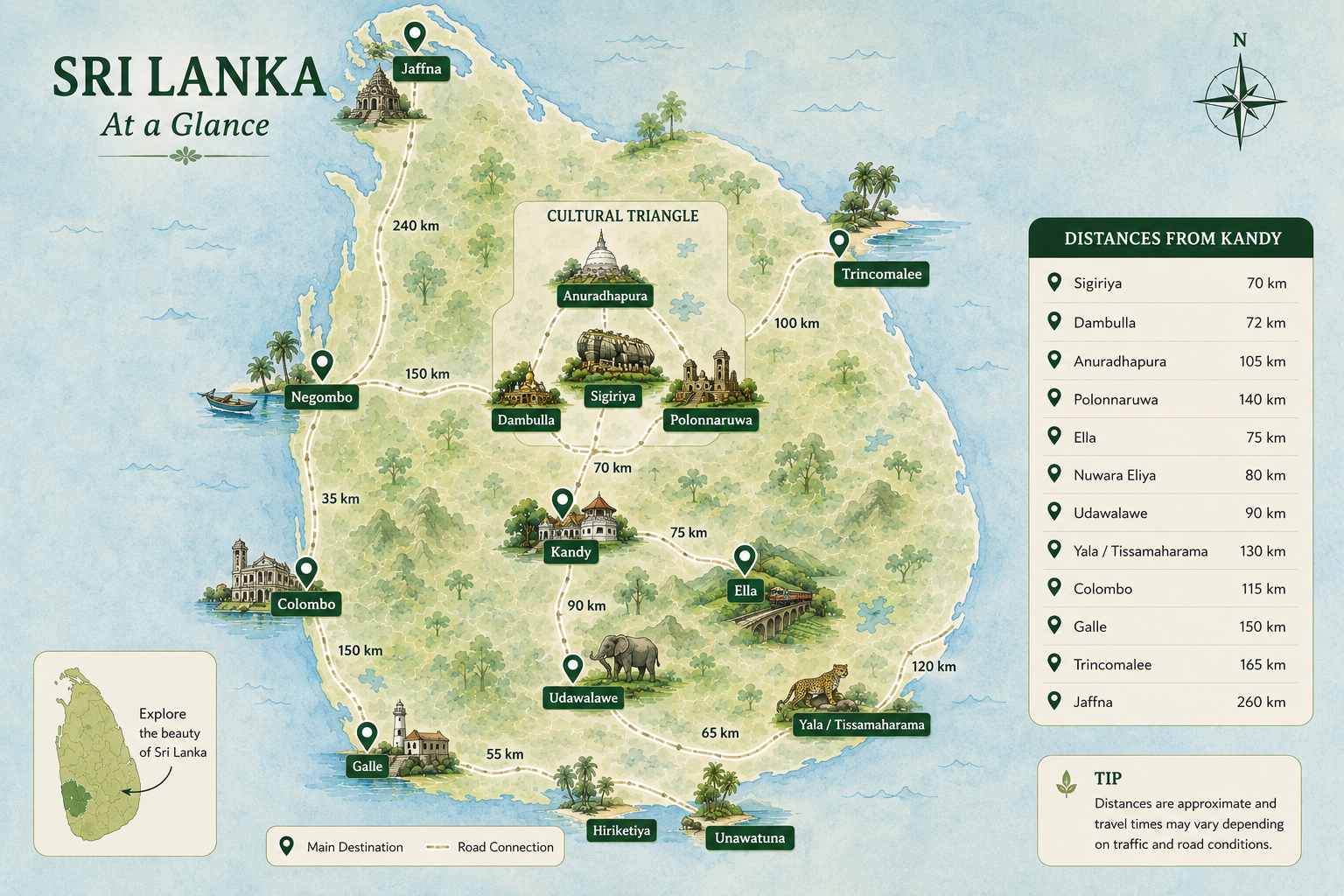
Sri Lanka at a Glance
Capital: Sri Jayawardenepura Kotte
Main international airport: Bandaranaike International Airport (CMB)
Currency: Sri Lankan Rupee (LKR)
Languages: Sinhala and Tamil, with English widely used in tourism
Time zone: GMT +5:30
Driving: Left-hand side
Ideal first trip: Around 2 weeks
Best way to travel: A combination of trains, private transfers, taxis and/or buses
Visa / ETA: Check the latest requirements through the official Sri Lankan immigration or ETA website before travelling
Beyond Path Asia tip: Never plan Sri Lanka by distance alone. A route that looks short on the map can still take several hours.
Planning a trip to Sri Lanka?
Start with your travel dates, the coast that suits the season and a realistic number of overnight stops. Then add the experiences that matter most to you: ancient cities, hill-country scenery, a safari or time by the sea.
Check these essentials before you book
Entry documents: check the passport and visa or ETA requirements for your nationality through Sri Lanka’s official ETA service and your government’s travel advice.
Current conditions: review FCDO travel advice or Dutch government travel advice, including weather and transport disruption.
Reservations: check train availability through Sri Lanka Railways and avoid tight onward connections.
Insurance and health preparation: check cover for your planned activities and arrange individual advice from a qualified travel-health professional.
Use the sections below to build a route with enough time to enjoy each place.
Table of Contents
Why Visit Sri Lanka?
What to Know Before You Start Planning
Best Time to Visit Sri Lanka
15 Essential Sri Lanka Travel Tips
7 Common Mistakes First-Time Visitors Make
Is Sri Lanka Safe?
How Much Does Sri Lanka Cost?
What to Pack for Sri Lanka
Our Recommended 2 Week Sri Lanka Route
Frequently Asked Questions
Why visit Sri Lanka?
Sri Lanka's biggest strength is its variety. In the Cultural Triangle, ancient cities such as Anuradhapura and Polonnaruwa sit alongside Sigiriya's dramatic rock fortress and the cave temples of Dambulla. Travel south and the landscape changes completely. Around Kandy, Nuwara Eliya and Ella, tea plantations cover the mountains and trains wind slowly through misty valleys. Wildlife adds another dimension.
Depending on the national park, you may have the opportunity to see elephants, crocodiles, monkeys, deer, extraordinary birdlife and — with luck — leopards in the wild.
Then there is the coast. Arugam Bay, Hiriketiya, Mirissa, Unawatuna and Galle all offer completely different versions of coastal Sri Lanka. Few destinations combine history, mountains, wildlife, food and beaches this easily.
What to know before you start planning
Before building your route, there are three things we'd keep in mind.
Sri lanka feels bigger than it looks; Distances on the map can be misleading. Roads pass through towns and villages, mountain routes are slow and traffic can add significant time to a journey. A relatively short distance can easily turn into several hours on the road. Build your itinerary around realistic travel days, not kilometres.
You don't need every famous stop; Anuradhapura, Polonnaruwa, Sigiriya and Dambulla are all worthwhile. That doesn't mean every traveller needs all four. The same applies to safaris and beaches. A better question is: Which experiences add something different to my trip?
Leave some flexibility; Ella is somewhere many travellers want to stay longer than expected. The same often happens on the coast. If possible, avoid booking every hour of every day before arriving. One free afternoon can make an itinerary feel dramatically more relaxed.
Best time to visit Sri Lanka
There isn't one simple best time to visit the entire country. Sri Lanka is influenced by different monsoon systems, which means weather conditions can vary considerably between regions at the same time.
South & West Coast
For destinations such as: Galle • Unawatuna • Mirissa • Hiriketiya roughly December to March is generally one of the most reliable periods for beach conditions. April can also work well, although the weather becomes more transitional. Outside these months, don't assume it rains continuously. Conditions simply become less predictable.
Hill Country
Kandy • Nuwara Eliya • Ella • Haputale can be visited throughout the year. December to March often works particularly well as part of a classic first-time itinerary, but weather in the mountains can change quickly at any time. Pack a light rain layer and something warmer for the evenings.
East Coast
For destinations such as: Arugam Bay • Trincomalee the stronger beach season generally shifts towards the middle of the year. This makes the east coast an excellent alternative when conditions on parts of the south and west coasts are less predictable.
Cultural Triangle
Sigiriya • Dambulla • Anuradhapura • Polonnaruwa can be visited during much of the year. Here, heat is often as important a consideration as rainfall. Start major archaeological sites early whenever possible.
Which season should you choose?
For a classic first-time route combining: Cultural Triangle → Kandy → Ella → Safari → South Coast Roughly December to March is generally one of the easiest periods. Travelling during the middle of the year? Don't simply copy the same route. Change the coast. Our December to March Sri Lanka Itinerary and April to November Sri Lanka Itinerary show how we'd adapt the journey to seasonal conditions.
Beyond Path Asia tip: Weather patterns vary from year to year. Use seasonal guides to plan your route, but check current local forecasts shortly before travelling.
15 Essential Sri Lanka Travel Tips
1. Slow down your itinerary
This is probably the single most important Sri Lanka travel tip. Remove one destination. Most first-time itineraries include too much. Three nights somewhere often creates a better experience than one night each in three different destinations — particularly when long transfers are involved. If you're debating whether to add one more stop, our default answer would usually be don't. Use that night somewhere you're already visiting.
2. Around two weeks is ideal for a first trip
You can absolutely see Sri Lanka in one week. Our 7 Day Sri Lanka Itinerary shows how to combine ancient sites, the hill country, wildlife and the south coast in a realistic shorter route. But around two weeks gives you much more flexibility. A simple way to think about it is: 7 days — highlights; 14 days — ideal balance; 21 days — deeper, slower trip. With two weeks, you can spend several nights in key places, include a safari and still have proper beach time without changing accommodation every day.
3. Don't trust distance alone
A journey of 100 kilometres in Sri Lanka doesn't necessarily mean a quick transfer. Traffic, towns, road conditions, weather and mountain routes all affect journey times. Google Maps is useful for orientation, but we'd never plan a tightly timed day around the fastest estimate shown. Leave a buffer.
Beyond Path Asia tip: On longer transfer days, don't book an important activity immediately after your expected arrival time.
4. Start important days early
Some of Sri Lanka's most popular places are considerably better early in the day. At Sigiriya, an early start means cooler temperatures and usually fewer people on the stairs. Archaeological sites are easier before the strongest midday heat. Safari departures are often early too, giving you cooler temperatures and a different wildlife experience. You don't need to wake before sunrise every day. Save the early starts for the places where they actually improve the experience.
5. Don't skip the Cultural Triangle
It's tempting to build a first Sri Lanka trip almost entirely around Ella, safaris and beaches. We wouldn't. The Cultural Triangle adds the historical context that makes the trip feel much more complete. Highlights include: Sigiriya; Dambulla; Anuradhapura; Polonnaruwa; Minneriya and Kaudulla. You don't need them all. For a shorter first trip, Sigiriya and Dambulla combine particularly well. With more time, add Anuradhapura or Polonnaruwa depending on your route and interest in history. Read our complete Sri Lanka Cultural Triangle Guide to compare the main sites.
6. Take the Hill
Country train — but plan it properly - The railway through Sri Lanka's hill country deserves its reputation. Tea plantations, mountain villages, forests and misty valleys make the journey towards Ella one of the country's most memorable travel experiences. But treat it as an experience rather than a perfectly predictable transfer. Delays can occur and popular trains can become busy. If you want a reserved seat, check the official Sri Lanka Railways reservation system when the booking window opens. Reserved seats are currently released 30 days before travel, but booking procedures can change, so always verify the latest information through the official railway system before your trip. A reserved seat is particularly useful when travelling with children or luggage. Read our complete Kandy to Ella Train Guide for current booking information, seat classes and practical advice.
7. Renting a tuk
tuk can be brilliant — but it changes the entire trip - Driving your own tuk-tuk gives you enormous freedom. You can stop at roadside restaurants, viewpoints, villages and beaches that you'd otherwise pass straight by. But it isn't the fastest or easiest way to travel. You'll need to meet the current driving and licensing requirements, become comfortable with Sri Lankan traffic and allow significantly more time between destinations. Tuk-tuks are also not permitted on Sri Lanka's expressways. That has a major impact on longer routes. For adventurous travellers with enough time, travelling by tuk-tuk can be one of the most memorable ways to experience the country. For a short first trip, trains combined with private transfers are usually easier. Read our complete Driving a Tuk Tuk in Sri Lanka Guide before deciding.
8. Carry some cash
Cards are accepted at many hotels, restaurants and tourist businesses, but cash is still useful throughout Sri Lanka. You'll commonly need it for: tuk-tuks; small restaurants; markets; local shops; guesthouses; tips; roadside stops; ATMs are widely available in major towns and tourist areas. We wouldn't carry your entire travel budget in cash. Withdraw smaller amounts when needed and keep your everyday money separate from your main cards and valuables.
9. Use PickMe where it works
PickMe can be extremely useful for booking tuk-tuks and cars. In areas with good coverage, it provides a straightforward way to arrange transport and gives you a clearer idea of the expected fare. But coverage isn't equally reliable everywhere. In smaller towns, remote areas and some beach destinations, your accommodation may still be the easiest way to arrange local transport. Don't rely on having app-based transport available at every stop.
10. Dress respectfully at temples
Sri Lanka's temples aren't simply tourist attractions. Many remain important active places of worship. Cover your shoulders and knees, remove shoes where required and follow local instructions. Temple floors can become extremely hot in the middle of the day, so socks can be surprisingly useful. Avoid touching or climbing sacred structures and don't pose disrespectfully with Buddha statues. A small amount of awareness makes a big difference.
11. Prepare for Both Heat and Cool Mountain Weather
Much of Sri Lanka is hot and humid. Carry water, use sun protection and avoid planning every outdoor activity for the middle of the day. But don't pack only for tropical temperatures. Nuwara Eliya, Haputale and parts of the hill country can feel surprisingly cool, particularly early in the morning and after dark. Bring one lightweight warmer layer. You'll probably use it.
12. Make Sri Lankan Food Part of the Trip
Sri Lankan food shouldn't simply fill the gaps between attractions. It should be one of the attractions. Start with rice and curry, but remember that this usually means several different curries, dhal, sambol and accompaniments served together. Also look for: hoppers; string hoppers; kottu roti; dhal curry; coconut sambol; roti; fresh tropical fruit. Don't assume the most polished restaurant serves the most memorable food. Some of the best meals can be found in simple local restaurants.
13. Sri Lanka is excellent for vegetarians
Vegetarian travellers have an enormous amount of choice. Dhal, pumpkin curry, jackfruit, beetroot, aubergine, coconut sambol and many other dishes are commonly available. One important detail: don't automatically assume every vegetable dish is vegetarian or vegan. Ingredients such as Maldive fish can sometimes appear in sambols and other preparations. If this matters to you, ask. Our Vegetarian Food in Sri Lanka Guide explains what to order and which dishes to look for.
14. Choose your safari according to your priorities
Don't automatically book Yala because it's the national park you've heard most about. Different parks offer different experiences.
Udawalawe — a strong choice if elephants are your main priority.
Yala — known for varied wildlife and the possibility of seeing wild leopards. Sightings are never guaranteed.
Wilpattu — larger, forested and appealing if you prefer a more remote wilderness experience.
Minneriya / Kaudulla — particularly known for elephant movements during suitable seasonal conditions.
The best safari isn't necessarily the most famous one. It's the one that fits your route, season and wildlife priorities. Read our complete Sri Lanka Safari Guide before choosing your park.
15. Leave room for the unexpected
Not every hour needs to be planned. Some of our favourite memories from Sri Lanka happened between the places we originally travelled there to see. A roadside king coconut. A view that made us stop. A beach we hadn't planned to visit. A lunch that lasted much longer than expected. Build enough flexibility into your itinerary to allow those moments to happen. Sri Lanka becomes much more enjoyable when you stop trying to control every hour of the journey.
7 Common mistakes first-time visitors make
The tips above explain how we'd plan Sri Lanka. These are the mistakes we'd specifically try to avoid.
1. Changing hotels almost every night
A route can look efficient on paper and feel exhausting in reality. Constant packing, checking out and transferring means you're spending more time managing the trip than experiencing it. Better: aim for two- or three-night stays wherever the itinerary allows.
2. Choosing the coast without looking at the season
Don't automatically add Mirissa or Arugam Bay because you've seen photos online. The better coast depends heavily on your travel dates. Better: choose your beach section after deciding when you're travelling.
3. Waiting too long to check train reservations
The scenic hill-country railway is extremely popular. If a reserved seat matters to you, don't leave it until the final days before travel. Better: check the official system when the current reservation window opens.
4. Planning tight connections after long transfers
Sri Lankan journey times can change because of traffic, road conditions, weather and delays. Better: don't place a non-refundable timed activity immediately after an important road or train journey.
5. Visiting every ancient site because it's on the route
After several archaeological sites, even extraordinary ruins can begin to blend together. Better: choose according to your interest in history rather than trying to complete every famous site.
6. Booking a safari before choosing the right National Park
A great safari operator cannot change the fact that you've chosen the wrong park for your priorities or season. Better: choose the park first, then compare operators.
7. Treating rest days as wasted time
An empty afternoon may look inefficient when planning from home. After ten days of travelling, it can become one of your favourite parts of the trip. Better: deliberately leave breathing room in longer itineraries.
Is Sri Lanka safe for tourists?
Many travellers visit Sri Lanka without serious problems, but we'd approach safety exactly as we would elsewhere in Asia: with normal precautions and awareness. Keep valuables secure, use reputable transport and take extra care when travelling alone late at night. Be cautious when someone is putting pressure on you to change your plans, visit a particular shop or immediately purchase a tour. Traffic deserves particular attention. Cross roads carefully and don't assume vehicles will always stop because you're at a pedestrian crossing. If you're driving your own tuk-tuk, give yourself time to adjust to local traffic rather than making your first driving day a long-distance journey. Travel conditions and official advice can change.
Always check the latest travel advice from your own government shortly before departure.
Is Sri Lanka good for families?
Yes. Wildlife, trains, beaches, pools and outdoor experiences make Sri Lanka an excellent family destination. But families benefit even more from travelling slowly. Too many hotel changes, long road journeys and packed sightseeing days can become tiring for children surprisingly quickly. We'd prioritise:
fewer accommodation changes
private transfers on difficult travel days
at least one relaxed beach section
one carefully chosen safari
flexibility around meal and rest times
Read our complete Sri Lanka with Kids Guide for family-specific itinerary advice.
How much does a Sri Lanka trip cost?
Sri Lanka works across a wide range of travel styles. You can stay in locally run guesthouses, eat at small restaurants and travel by train or bus. Or you can combine private drivers, boutique hotels, safari lodges and luxury resorts. The biggest budget variables are usually:
Accommodation - Guesthouses can offer excellent value, while boutique hotels and luxury resorts increase costs quickly.
Transport - Public transport can be inexpensive. Frequent private transfers are considerably more expensive.
Safaris - Park admission, jeep hire and other inclusions make wildlife experiences one of the bigger trip expenses.
Major Attractions - Historic sites and archaeological complexes can add significantly to sightseeing costs.
Food - Local restaurants are generally much more affordable than international-style restaurants and hotel dining.
Rather than publishing a fixed daily budget here that may quickly become outdated, we've put detailed planning figures in one place. Read our complete Sri Lanka Travel Budget Guide for current cost estimates and a breakdown by travel style.
What to pack for Sri Lanka
You don't need an enormous packing list. Lightweight clothing plus a few destination-specific items will cover most trips.
Everyday essentials - Lightweight breathable clothing; Comfortable walking shoes or sandals; Swimwear; Sun protection; Insect repellent; Reusable water bottle; Power bank; Universal travel adapter; Light rain jacket or compact umbrella; Small day bag.
For temples - Bring clothing that properly covers your shoulders and knees. A lightweight scarf or sarong can be useful, but we'd still pack at least one outfit suitable for religious sites. Socks are useful on hot temple floors.
For the Hill Country - Bring one light sweater, fleece or other warmer layer. Ella can feel cool in the evening, while Nuwara Eliya can be considerably colder than the coast.
For safari - Keep it simple: lightweight clothing; sun protection; water; camera; binoculars if you have them; light layer for early departures.
What you probably don't need - Too many heavy outfits. Too many pairs of shoes. And enough clothes for your entire trip. Laundry services are widely available in tourist destinations, making it easy to travel relatively light.
Our recommended 2-week Sri Lanka itinerary
For many first-time visitors, around two weeks gives the best balance between variety and pace. A classic route looks roughly like this:
Negombo → Cultural Triangle → Kandy → Ella → Safari → Coast
It works because every region adds something different. The Cultural Triangle gives you history. Kandy and Ella take you into the mountains. A safari adds wildlife. And the coast gives the itinerary somewhere to slow down at the end. The exact safari and beach section should change according to your season, but the basic route makes an excellent first introduction.
Our complete 2 Week Sri Lanka Itinerary breaks the journey down day by day, including where to stay, what to prioritise and how to structure your travel days.
Only have one week? See our 7 Day Sri Lanka Itinerary.
Have three weeks? Our 3 Week Sri Lanka itinerary adds more breathing room and gives you more freedom to adapt the route according to the season.
Frequently Asked Questions
-
Around two weeks is ideal for many first-time visitors. Seven days is enough for a carefully planned highlights route. Three weeks allows you to travel more slowly, explore additional regions or spend longer in places you particularly enjoy. If you have fewer than ten days, we'd resist the temptation to cover the entire island.
-
There isn't one perfect month for the entire country. For a classic itinerary combining the Cultural Triangle, hill country and south coast, roughly January to March is generally an excellent period. During the middle of the year, the east coast becomes much more attractive. Choose your route according to the regions you're visiting rather than looking for one universally perfect month.
-
A classic route is:
Negombo → Cultural Triangle → Kandy → Ella → Safari → Coast
It's popular for good reason. Within one journey, you experience ancient Sri Lanka, mountain landscapes, wildlife and beaches without excessive backtracking. The exact safari park and coast should be chosen according to your travel dates and priorities.
-
Sri Lanka can suit budget, mid-range and luxury travellers. Accommodation and local food can offer good value, while private transport, safaris, major attractions and luxury accommodation can substantially increase the total cost. Use our Sri Lanka Travel Budget Guide to build a budget around the way you actually want to travel.
-
Many trips are trouble-free, but normal travel precautions still apply. Secure your valuables, use reputable transport, take care in traffic and check current government travel advice before departure.
-
Yes, provided you meet the current legal and licensing requirements.
But renting a tuk-tuk changes the entire pace of your journey. You'll travel more slowly, you cannot use expressways and you'll need to become comfortable with local traffic. For the right traveller, that's part of the appeal. Read our Driving a Tuk Tuk in Sri Lanka Guide before deciding.
-
Yes. Although cards are accepted in many hotels and restaurants, cash is still widely used for local transportation, markets, smaller guesthouses, and family-run restaurants.
-
If you want a reserved seat, we'd recommend checking as soon as the official reservation window opens. Reserved seats are currently released 30 days before travel and popular services can sell out. Because schedules and booking procedures can change, always verify the current information through the official Sri Lanka Railways system before travelling.
-
It depends on what matters most to you. Choose Udawalawe if elephants are a priority. Choose Yala if the possibility of seeing a wild leopard is particularly important. Choose Wilpattu for a more forested wilderness experience. Consider Minneriya or Kaudulla for seasonal elephant movements in the Cultural Triangle. No park can guarantee wildlife sightings. Our Sri Lanka Safari Guide compares the major options in more detail.
-
Very. Sri Lankan cuisine includes a huge range of vegetable curries, dhal, coconut-based dishes, hoppers and other meat-free food. Just remember that ingredients such as Maldive fish can sometimes be used in dishes that otherwise appear vegetarian. Our Vegetarian Food in Sri Lanka Guide explains what to look for and what to order.
Continue planning your Sri Lanka adventure
Now that you know the essentials, start building your perfect route:
7 Day Sri Lanka Itinerary — See the highlights in one unforgettable week.
2 Week Sri Lanka Itinerary — Our favourite route for first-time visitors.
3 Week Sri Lanka Itinerary — Slow down and explore even more of the island.
Sri Lanka Cultural Triangle Guide — Ancient cities, temples and iconic landmarks.
Sri Lanka Safari Guide — Compare the country's best national parks.
Sri Lanka South Coast Guide — Find the beaches and coastal towns that suit your trip.
Build a route with room to enjoy it
Choose a few places you want to experience properly, book the arrangements that matter and leave space between them. A slower lunch, an extra night in the hills or a free beach afternoon can make the journey feel more relaxed.
Start with the two-week Sri Lanka itinerary, then adapt the coast, safari and pace to your dates and interests.
More Sri Lanka inspiration