The ultimate Sri Lanka travel route for April to November
Sri Lanka is a destination shaped by rhythm. Not just in culture, food or daily life, but in its seasons. While many travelers instinctively look at the island for winter sun, those who travel between April and November discover a completely different side of Sri Lanka—one that feels quieter, more authentic and surprisingly diverse.
This is the season when the island turns itself inside out. While the southwest coast experiences its monsoon, the east coast comes alive. Calm seas, long empty beaches, and a slower, more local atmosphere define this time of year. Combined with the cultural heart of the island and the lush hill country, it creates a journey that feels both varied and perfectly balanced. At Beyond Path Asia, we design our itineraries around more than geography. We also consider pace, season and the natural flow between destinations. This itinerary is built around flow—starting with culture, moving into nature, and ending at the coast where everything softens. This route is ideal for 2 to 3 weeks and is perfectly suited for couples, families and first-time visitors looking for something beyond the obvious.
Why travel Sri Lanka between April and November?
Sri Lanka’s climate is unique. When the southwest monsoon (Yala monsoon) hits from April onwards, much of the south and west coast becomes wetter. But at the same time, the north and east coast enter their best season. Between May and September especially, the east coast—places like Trincomalee, Nilaveli and Pasikudah—offers some of the calmest seas in the Indian Ocean. Think crystal-clear water, soft sandy beaches and far fewer crowds than the south. Meanwhile, the Cultural Triangle remains accessible, and the hill country is at its most dramatic, with misty mornings and vibrant green landscapes. This makes April to November not just a good time to visit Sri Lanka—but one of the most rewarding, if you follow the right route.
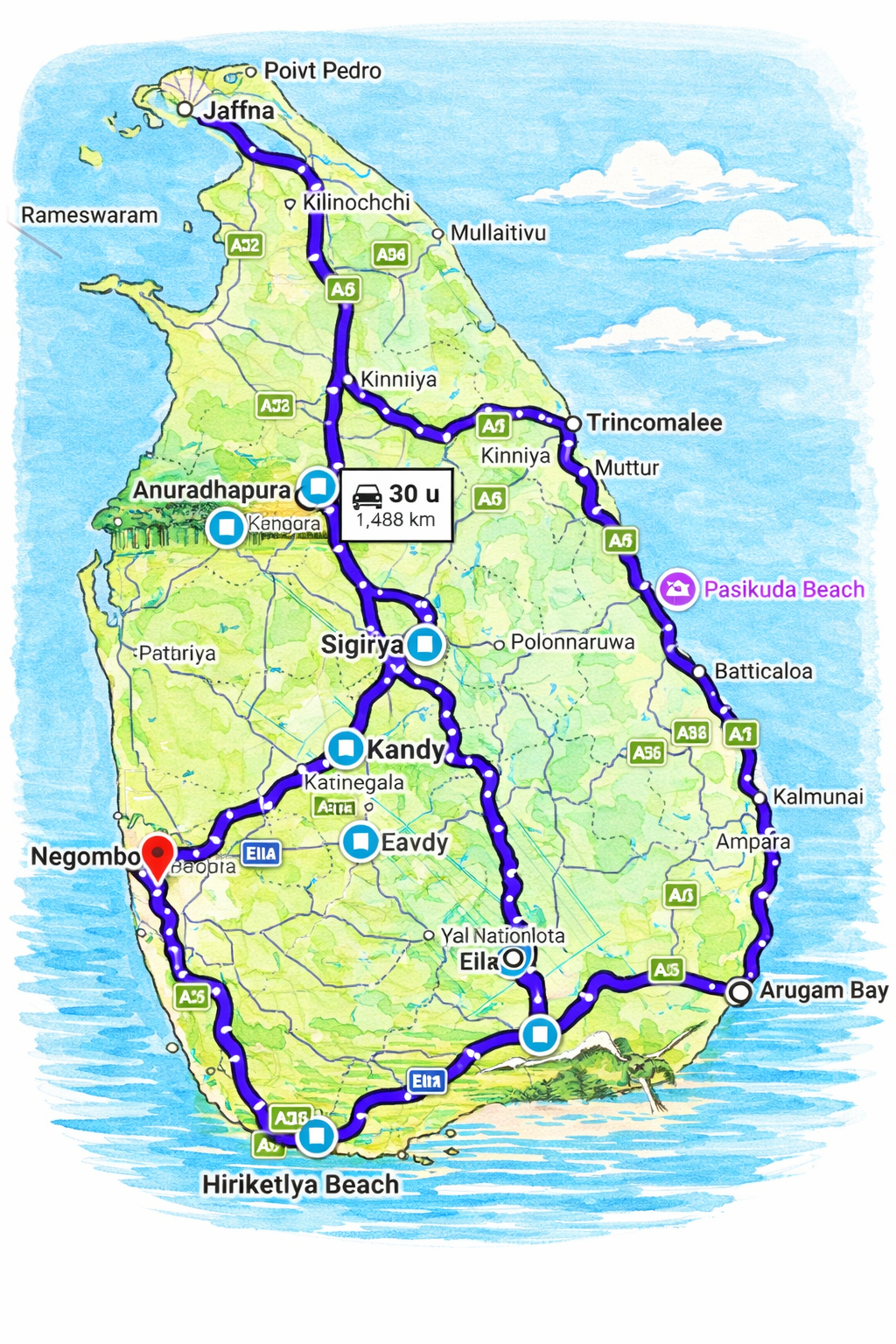
Arrival in Colombo and transfer to Negombo (1 night)
Cultural Triangle: Sigiriya and surroundings (3 nights)
Anuradhapura or Polonnaruwa (1–2 nights)
Ella (2-3 nights)
East Coast Beaches: Trincomalee & Nilaveli (4–5 nights)
Jaffna (2–3 nights)
Return to Colombo (1 night)
Arrival in Colombo and transfer to Negombo (1 night)
Most journeys begin in Colombo, but just like in the winter route, we recommend heading straight to Negombo. It’s close to the airport and offers an easy transition into the country. Negombo feels unpolished in places, but that’s part of its charm. Fishing boats line the shore, the lagoon reflects the changing light, and life unfolds at a slower pace than in Colombo. After a long journey, it’s exactly what you need. Spend your first evening walking along the beach or enjoying a relaxed dinner by the water. Keep it simple. Sri Lanka will reveal itself gradually.
For accommodation, budget travelers can stay at Sea Breeze Guesthouse, while mid-range comfort can be found at Hotel J Negombo. For a more refined start, Jetwing Blue offers beachfront luxury. Families often enjoy Goldi Sands Hotel, thanks to its space and easygoing atmosphere.
Cultural triangle: Sigiriya and surroundings (3 nights)
From Negombo, the journey continues inland toward the Cultural Triangle. The drive takes you through gradually changing landscapes, from coastal plains to lush countryside dotted with rice fields and small villages. Sigiriya is one of Sri Lanka’s most iconic destinations, known for the towering Lion Rock that rises dramatically from the surrounding jungle. Climbing Sigiriya at sunrise or early morning is an unforgettable experience, with panoramic views stretching across the region. Yet what makes this area truly special is not just the famous landmarks, but the quieter, more local experiences. A bicycle ride through the countryside reveals a different side of Sri Lanka: children waving as you pass, farmers working in the fields, and water buffalo cooling off in lakes. Nearby, Pidurangala Rock offers an alternative climb with equally stunning views, often with fewer crowds. The ancient cave temples of Dambulla add a cultural layer, with centuries-old Buddha statues and intricate murals carved into rock.
For accommodation, budget travelers will find welcoming homestays such as Sigiri Rock Side Home Stay, where hospitality is as memorable as the location. Mid-range options like Elephas Resort & Spa provide comfort surrounded by nature. For a boutique luxury experience, Water Garden Sigiriya stands out with its spacious villas and views of Sigiriya itself. Families often love Aliya Resort & Spa, which combines space, pools and a relaxed atmosphere suitable for all ages.
Anuradhapura or Polonnaruwa (1–2 nights)
As your journey through Sri Lanka’s Cultural Triangle continues, Anuradhapura or Polonnaruwa introduces a deeper layer of history—one that feels less curated and more quietly profound. These ancient cities are not simply archaeological sites; they are living landscapes where past and present continue to exist side by side. Anuradhapura is vast, spiritual and immersive. Scattered across a wide area, its monumental stupas rise above the surrounding plains, while pilgrims dressed in white move slowly between sacred sites. The atmosphere here is not defined by sightseeing, but by a sense of continuity. It’s a place where rituals have remained unchanged for centuries, and where time feels almost suspended.
Polonnaruwa offers a different kind of experience. More compact and easier to navigate, it invites exploration at a slower pace, often by bicycle. The ruins are remarkably well preserved, and the setting—surrounded by greenery and open space—adds to its calm, reflective character. The Gal Vihara statues, carved from a single granite rock, are among the most striking examples of Sri Lanka’s ancient artistry.
Choosing between the two depends largely on your travel style. Anuradhapura feels more expansive and spiritual, while Polonnaruwa is more accessible and structured. Both, however, offer a meaningful insight into the island’s rich heritage.
Accommodation in this region is generally more modest, but carefully selected stays still offer comfort and atmosphere. Mid-range options such as EKHO Lake House Polonnaruwa provide a peaceful setting close to nature, while smaller guesthouses offer a more personal and local experience. Families often choose to base themselves in Sigiriya and visit these sites as a day trip, allowing for more flexibility. A stay of one to two nights is enough to experience the essence of these ancient cities—unhurried, reflective, and deeply connected to Sri Lanka’s identity.
Ella (2-3 nights)
From the dry plains, the journey rises into the hills. This is where Sri Lanka slows down again, where the air cools and the scenery becomes almost cinematic. Kandy is your first stop, offering a mix of culture and city life. The Temple of the Tooth remains one of the most important religious sites in the country, while the surrounding hills provide beautiful viewpoints and quieter corners. From here, the train journey toward Ella is one of the highlights of any trip to Sri Lanka. Rolling tea plantations, mist-covered hills and small villages pass by slowly, making the journey as memorable as the destination. Ella itself is relaxed and accessible. Short hikes, waterfalls and viewpoints are all within easy reach, but there’s no pressure to do it all. It’s a place to enjoy the surroundings at your own pace.
Accommodation ranges from budget-friendly stays like Hangover Hostels Ella to mid-range comfort at Morning Dew Hotel. For a luxury experience, 98 Acres Resort & Spa blends seamlessly into the landscape. Families often choose EKHO Ella, which offers both space and convenience.
Arugam Bay (3–4 nights)
As you leave the hills behind, the road leads you toward the east coast—and a completely different atmosphere. Arugam Bay is known worldwide as a surf destination, but even if you don’t surf, it’s worth staying here. The energy is relaxed, international yet still local, and far less developed than Sri Lanka’s southern beaches. Days here are simple. Mornings start early, often with surfers heading into the water. The rest of the day unfolds slowly: beach time, good food, and long, warm evenings. Nearby, Kumana National Park offers a quieter alternative to Yala, with excellent birdlife and the chance to spot elephants and crocodiles.
Budget travelers can stay at places like The Spice Trail, while mid-range options include Stay Golden. For something more unique, boutique stays and eco-lodges offer comfort without losing the laid-back feel. Families often choose beachfront accommodations slightly outside the main town for more space and tranquility.
East Coast Beaches: Trincomalee & Nilaveli (4–5 nights)
The final part of your journey brings you further north along the east coast, where Sri Lanka reveals one of its most underrated regions. Trincomalee and nearby Nilaveli offer some of the best beaches in the country during this season. The sea is calm and clear, perfect for swimming and snorkeling. Pigeon Island National Park is a highlight, with coral reefs and colorful marine life just offshore. What makes this region special is its sense of space. Beaches feel wide and open, tourism is present but not overwhelming, and there’s a sense that you’ve discovered a different side of Sri Lanka.
Accommodation here ranges from simple beachfront guesthouses to refined resorts. Budget travelers can find relaxed stays close to the beach, while mid-range options like Trinco Blu by Cinnamon offer comfort and location. For luxury, Uga Jungle Beach provides a unique blend of nature and design. Families often prefer Amaranthe Bay Resort, thanks to its spacious layout and calm setting.
Jaffna (2–3 nights)
For those with more time, a journey to Jaffna adds a layer to Sri Lanka that few travelers experience. Located in the far north, this region feels distinctly different—shaped by Tamil culture, quieter in pace, and far less influenced by tourism. Arriving in Jaffna is less about ticking off highlights and more about shifting perspective. The atmosphere is understated, the rhythm slower, and daily life unfolds with a sense of authenticity that feels increasingly rare. Exploration here is gentle and intentional. The Nallur Kandaswamy Temple is a focal point, where color, ritual and devotion come together in a way that feels both vibrant and deeply rooted. The old Dutch fort, weathered yet atmospheric, offers a glimpse into the region’s layered history. For those willing to venture further, nearby islands such as Delft introduce a landscape that feels almost untouched, where time seems to move differently. Jaffna’s cuisine is another defining element. Known for its bold spices and distinctive flavors, it offers a culinary experience that sets it apart from the rest of the island. Meals are often simple in setting, yet rich in character.
Accommodation remains modest compared to other parts of Sri Lanka, but that is part of its appeal. Properties like Jetwing Jaffna offer comfort without losing the local connection, while smaller guesthouses provide a more personal experience. Jaffna is not a highlight-driven destination. It is a place of nuance, culture and quiet depth—an addition that transforms your journey into something more complete.
Return to Colombo (1 night)
As your journey through Sri Lanka comes to an end, a final night in Colombo offers a gentle transition back to the pace of everyday life. After weeks of shifting landscapes—coastlines, temples, hills and quiet villages—the capital introduces a different energy. More urban, more contemporary, yet still unmistakably Sri Lankan. Colombo is not a city of obvious highlights, but that is precisely where its appeal lies. It reveals itself gradually, through its contrasts. Colonial buildings stand alongside modern architecture, local markets sit just minutes from stylish cafés, and the rhythm of daily life feels both dynamic and grounded. This final stop is best experienced without pressure. A walk along Galle Face Green at sunset, a relaxed dinner in one of the city’s growing number of restaurants, or simply time to unwind at your hotel allows the journey to settle.
Accommodation in Colombo reflects the city’s diversity. Mid-range options offer comfort and central locations, while properties like Shangri-La Colombo provide a more refined, international feel with views over the Indian Ocean. Families often prefer Cinnamon Grand Colombo, where space, facilities and multiple dining options create an easy and comfortable stay. One night here is not about exploration, but about closure. A moment to reflect, to slow down, and to carry the rhythm of Sri Lanka with you as you leave.
Ending your journey & why this route works
This route follows the seasons. It avoids the monsoon, embraces the best of the east coast, and combines it with Sri Lanka’s cultural and natural highlights. It also flows naturally. From coast to culture, from history to hills, from adventure to relaxation. Each part of the journey builds on the previous one, without feeling rushed.
Sri Lanka between April and November is often overlooked—but those who travel during this time are rewarded with something special. Fewer crowds, authentic experiences, and a coastline that feels untouched. This route is designed to help you experience the island in a way that feels complete, balanced and personal. Because in the end, travel is not about the places you visit. It’s about the way those places make you feel.
More Sri Lanka inspiration