The ultimate 3 week Sri Lanka itinerary
Sri Lanka is one of the best destinations in Asia for travelers who want variety without covering huge distances. In just a few weeks, you can move from ancient ruins and sacred temples to cool tea-covered mountains, from leopard-filled national parks to laid-back surf beaches and quiet stretches of tropical coastline. It is a country that feels rich, layered, and constantly changing, which is exactly why it works so well as a longer itinerary.
Three weeks is one of the best amounts of time for a first trip to Sri Lanka. It gives you enough time to experience ancient cities, the hill country, wildlife and the coast without turning every day into a race to the next hotel. You can stay two or three nights in places that deserve it, build in slower days and experience parts of the country that are difficult to combine on a shorter trip. This 21-day Sri Lanka itinerary takes you from the ancient cities of the Cultural Triangle through Kandy and the tea-covered highlands to Ella, wildlife-rich national parks and the coast. But there is one important thing to understand before following the route exactly: Sri Lanka's east and south coasts have different weather patterns.
This itinerary includes both, so think of it as a framework rather than a fixed route that works perfectly in every month of the year. During the main east-coast season, Arugam Bay fits naturally into the journey. During the main south-coast season, we'd consider skipping Arugam Bay and spending those extra nights around Ella, Yala or the south coast instead. That's one of the advantages of having three weeks. You have enough time to explore — but you don't need to see everything.
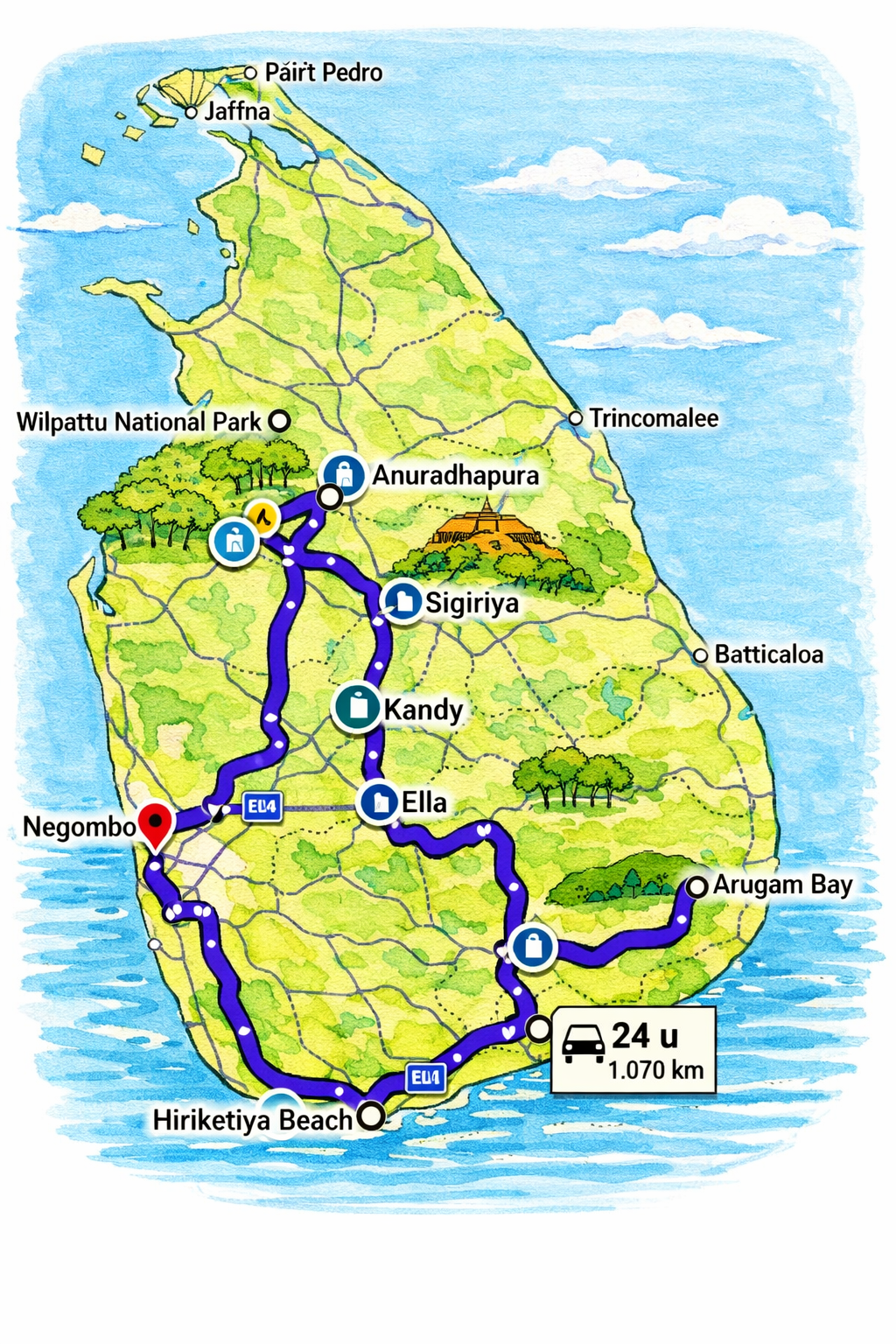
3 week Sri Lanka itinerary at a glance
Day 1 – Negombo - arrive & recover
Day 2 – Anuradhapura - Travel north
Day 3 – Anuradhapura - Explore the ancient city
Day 4 – Wilpattu - Safari experience
Day 5 – Sigiriya - Into the Cultural Triangle
Day 6 – Sigiriya & Dambulla - Two UNESCO highlights
Day 7 – Polonnaruwa or Slow Day - Choose according to your travel style
Day 8 – Kandy - Travel into the hill country
Day 9 – Kandy - Temples, gardens & culture
Day 12 – Ella - Hiking & mountain scenery
Day 13 – Arugam Bay - East coast
Day 14 – Arugam Bay - Beach & slow travel
Day 16 – Yala & Hiriketiya - Safari to the coast
Day 17 – Hiriketiya - Beach day
Day 18 – Mirissa or Unawatuna - Choose your south-coast base
Day 19 – South Coast - Beach day or whale watching
Day 20 – Galle & Final Night - Galle Fort + Colombo, Negombo or airport area
Beyond Path Asia tip: Don't treat this itinerary as a checklist. If you prefer slower travel, remove one destination rather than trying to squeeze even more into the route.
When does this 3 week Sri Lanka itinerary work best?
This is one of the most important things to understand about this route. Sri Lanka is affected by different monsoon systems, which means the east and south coasts don't share exactly the same ideal beach season.
Travelling roughly December to March?
Conditions are generally more favourable along the south and west coasts. For this version of the itinerary, we'd consider skipping Arugam Bay and using those two nights for an extra night in Ella, another wildlife stop or — our preference — more time on the south coast.
Travelling roughly April to November?
The east coast becomes much more appealing, making Arugam Bay a logical addition to the route. Conditions on the south coast can be more variable during parts of this period, although that doesn't mean the entire region becomes off-limits. The Cultural Triangle and much of the interior can be visited throughout the year, although rainfall and temperatures still vary. The key is not to choose your travel dates around this exact itinerary. Adjust the itinerary around your travel dates. Travelling at a specific time of year? See our April to November Sri Lanka Itinerary or December to March Sri Lanka Itinerary for routes designed more specifically around seasonal conditions.
Day 1 — Arrival in Sri Lanka & Overnight in Negombo
Most international travellers arrive at Bandaranaike International Airport, just north of Colombo. After a long flight, we wouldn't immediately start a four- or five-hour journey across the island. Spend your first night in Negombo instead. Negombo isn't Sri Lanka's most spectacular beach destination — and that's not why it's here. It's close to the airport, easy to reach and gives you a chance to recover before the journey begins properly. If you arrive early enough, walk along the beach, explore the lagoon area or simply find somewhere for your first Sri Lankan dinner. There's no need to fill this day with sightseeing.
Where to stay in Negombo
Luxury — Jetwing Blue - A large beachfront resort with spacious rooms, swimming pools and direct access to Negombo Beach. A comfortable first stop if you want an easy arrival after a long international flight.
Mid-range — Terrace Green Hotel & Spa - A smaller boutique-style property close to the beach. A good option if you prefer something quieter and more intimate than one of Negombo's larger resorts.
Budget — Regal Réseau Hotel & Spa - A comfortable, relatively affordable option close to the coast that works particularly well for a short first or final stay in Negombo.
Beyond Path Asia tip: Choose your Negombo hotel for convenience rather than treating this as one of your main beach stays. Much better beach days are coming later in the itinerary.
Day 2 — Negombo to Anuradhapura
Today the journey begins properly. Travel north towards Anuradhapura, one of Sri Lanka's ancient capitals and one of the most important Buddhist pilgrimage destinations on the island. Allow several hours for the journey. As you leave the busy west coast behind, the landscape gradually becomes greener and quieter, with villages, rice fields and roadside shrines replacing the urban surroundings. Anuradhapura is not simply an archaeological site. Ancient monuments sit alongside active places of worship, and that combination makes the city feel very different from many historic sites elsewhere in Asia. Don't try to explore the entire ancient city immediately after arriving. Check in, slow down and, if you still have enough time and energy, visit one or two nearby sites in the late afternoon. Seeing one of Anuradhapura's enormous white stupas for the first time is more than enough introduction.
Where to stay in Anuradhapura
Luxury — Uga Ulagalla - A beautiful high-end retreat outside the city, with private villas spread across extensive grounds. Best if you want tranquillity and don't mind staying away from the archaeological zone.
Mid-range — Heritage Hotel - A comfortable and practical base with convenient access to many of Anuradhapura's major sights.
Budget — Aryana Boutique Hotel - A smaller, good-value option for travellers primarily looking for a comfortable base while exploring the ancient city.
Day 3 — Explore Anuradhapura
Give Anuradhapura a full day. The ancient city is enormous and spread across a large area, so this isn't somewhere we'd recommend trying to explore entirely on foot. Hire a tuk-tuk, bicycle or driver, or consider exploring with a knowledgeable local guide. The ruins become much more meaningful once you understand the stories behind them. Among the most important places to see are Sri Maha Bodhi, Ruwanwelisaya and Jetavanaramaya. Sri Maha Bodhi is particularly significant. The sacred tree is traditionally believed to have grown from a cutting of the Bodhi tree under which Buddha attained enlightenment, and pilgrims continue to visit it today. That's what makes Anuradhapura so different from simply walking around an archaeological park. White-clad pilgrims carry flowers, monks move between temples and enormous stupas remain part of religious life rather than museum pieces.
How to explore Anuradhapura
If history is one of your main interests, this is one of the places where we'd seriously consider hiring a guide. If you prefer exploring independently, choose a handful of important sites rather than trying to tick off every ruin. Remember that many of these are active religious places. Dress respectfully, cover shoulders and knees and be prepared to remove your shoes at sacred sites. Spend a second night in Anuradhapura.
Day 4 — Anuradhapura to Wilpattu National Park
One of the advantages of travelling for three weeks is that you have enough time to include a quieter wildlife experience. Today head towards Wilpattu National Park. Wilpattu feels very different from Yala. The park is large, forested and known for its natural lakes or villus. Safari tracks wind through a landscape that can feel quieter and more remote than Sri Lanka's busiest safari areas. Leopards live here, but don't choose Wilpattu because you expect a guaranteed leopard sighting. Choose it for the overall wilderness experience. Depending on your arrival time, take an afternoon safari or stay close to the park and plan an early drive. Wildlife sightings are never guaranteed — and that uncertainty is part of a genuine safari.
Do you need both Wilpattu and Yala?
No. If wildlife is one of the main reasons you're visiting Sri Lanka, keeping both gives you two very different safari environments. If safari is only one part of your trip, choose Wilpattu or Yala and use the extra night somewhere else.
Where to stay near Wilpattu
Luxury — Leopard Trails Wilpattu - A high-end tented safari experience for travellers who want the accommodation itself to become part of their time in the wilderness.
Mid-range — The Backwaters Lodge - A quieter, nature-focused property that works well as a comfortable base for exploring Wilpattu.
Budget — Wilpattu Tree House Hotel - A simpler stay near the national park that works well if your priority is convenient safari access rather than resort-style facilities.
Beyond Path Asia tip: If you decide to skip Wilpattu, don't immediately replace it with another destination. Add the extra night to Ella or the coast instead.
Day 5 — Wilpattu to Sigiriya
After your safari, continue southeast towards Sigiriya and the heart of Sri Lanka's Cultural Triangle. This is one of the most atmospheric parts of the country. Jungle, lakes, village roads and huge rocky outcrops surround one of Sri Lanka's most recognisable landmarks: Sigiriya Rock. Keep the afternoon relatively relaxed. If you arrive with enough time and energy, Pidurangala Rock can be a spectacular introduction to the area. From the summit, Sigiriya rises dramatically from the landscape opposite. The final section requires some scrambling, so don't underestimate the climb or attempt it in unsuitable footwear. f you're tired after travelling, skip it. You have several nights in this region. There's no reason to rush.
Where to stay in Sigiriya
Luxury — Water Garden Sigiriya - Private villas surrounded by lakes and greenery, with beautiful distant views towards Sigiriya Rock.
Mid-range — Aliya Resort & Spa - A comfortable resort with a large swimming pool and excellent views across the surrounding landscape.
Budget — Sigiriya Village Hotel - A relaxed option surrounded by tropical gardens and conveniently located for exploring Sigiriya.
Day 6 — Sigiriya & Dambulla
Start early at Sigiriya Lion Rock. The ancient fortress is one of Sri Lanka's most famous landmarks, but it's worth remembering that you're visiting much more than a viewpoint. The route passes through landscaped gardens, ancient frescoes and the Lion's Paw terrace before climbing towards the remains of the palace complex at the summit. Starting early makes a significant difference. Temperatures rise quickly and the stairs become busier later in the morning. Allow enough time to explore rather than racing to the summit and immediately leaving. Later, travel to Dambulla Cave Temple. The atmosphere is completely different. Five cave shrines contain an extraordinary collection of Buddhist statues and centuries-old paintings, creating a much more intimate experience than Sigiriya's enormous open landscape. Together, Sigiriya and Dambulla make one of the strongest cultural days on this itinerary.
Do you need a guide?
You can visit both independently. However, if you're particularly interested in Sri Lanka's history, this is a day where a knowledgeable guide can add real value. Without context, it's easy to admire the sites visually while missing much of what makes them historically important.
Spend another night in Sigiriya.
Day 7 — Polonnaruwa or a Slower Day around Sigiriya
Don't automatically add another major attraction simply because you have three weeks. Today should depend on your travel style.
Option 1 — Polonnaruwa
Choose Polonnaruwa if you enjoy archaeology and want to see another of Sri Lanka's ancient capitals. The archaeological zone contains royal ruins, temples and the famous stone Buddha figures of Gal Vihara. The area is more compact than Anuradhapura and works particularly well by bicycle or tuk-tuk. If ancient history is one of the reasons you're visiting Sri Lanka, it's worth the trip.
Option 2 — Slow down around Sigiriya
If Anuradhapura, Sigiriya and Dambulla have already given you enough temples and ruins, don't force another archaeological site into the itinerary. Spend the day cycling through the countryside, choose a thoughtfully run village experience, enjoy your hotel or simply slow down.
Which would we choose?
For a first trip with a strong interest in history:
Polonnaruwa. For families, slower travellers or anyone beginning to experience temple fatigue:
Stay around Sigiriya. Spend a final night in Sigiriya.
Day 8 — Sigiriya to Kandy
Today the route turns south towards Kandy and Sri Lanka's hill country. If you're interested in Sri Lankan spices, you can stop around Matale on the way. Cinnamon, pepper, clove, nutmeg and other spices have played an important role in the country's history and cuisine. Be selective when choosing a spice garden, however. Some stops are primarily designed around selling products to visitors. Once in Kandy, focus on the Temple of the Sacred Tooth Relic. This is one of Sri Lanka's most important Buddhist sites and remains an active place of worship. If your timing works, visiting around a puja ceremony gives the temple a completely different atmosphere, with drumming, offerings and worshippers filling the complex. Dress respectfully and cover shoulders and knees.
Where to stay in Kandy
Luxury — The Kandy House - A beautifully restored historic property outside the busiest part of the city, surrounded by tropical gardens.
Mid-range — Kings Pavilion - A comfortable hillside hotel with views over Kandy's surrounding landscape.
Budget — Cafe Aroma Inn - A practical central choice close to Kandy Lake and the Temple of the Tooth.
Day 9 — Kandy
A three-week itinerary gives you the luxury of not leaving Kandy the morning after you arrive. Start with the Royal Botanic Gardens in Peradeniya, one of the most enjoyable green spaces in the area. Giant bamboo, palms, orchids and enormous lawns make this an easy place to spend several hours without feeling as though you're rushing between attractions. Later, return to central Kandy. Walk around part of Kandy Lake, explore the market or spend time simply watching daily life around the centre. If you're interested in traditional performance, a Kandyan dance show can be added in the evening. But don't feel you need to fill every hour. This is a deliberately slower day before travelling deeper into the mountains.
Spend a second night in Kandy.
Day 10 — Kandy to Nuwara Eliya
Continue into Sri Lanka's highlands towards Nuwara Eliya. The landscape changes dramatically as the road climbs higher. Tea plantations cover the hillsides, waterfalls appear beside the road and temperatures become noticeably cooler. Nuwara Eliya's colonial architecture and high-altitude climate give it a different atmosphere from almost everywhere else on the island. The main reason we'd include it in this itinerary, however, is tea country. Visit a reputable tea estate or factory and learn how tea moves from freshly picked leaves to the finished Ceylon tea in your cup. Rather than trying to visit several factories, choose one good experience and leave enough time to enjoy the surrounding landscape.
Where to stay in Nuwara Eliya
Luxury — Heritance Tea Factory - One of the area's most distinctive stays, created inside a former tea factory and surrounded by tea-covered hills.
Mid-range — Araliya Green Hills Hotel - A comfortable option with convenient access to Nuwara Eliya town.
Budget — Hotel Glendower - A smaller characterful property that works well for travellers wanting a more affordable base.
Day 11 — Nuwara Eliya to Ella by train
Travel to Nanu Oya station and board the train towards Ella. This is one of the most scenic sections of Sri Lanka's railway network. The train passes tea fields, mountain villages, forests and misty valleys as it slowly makes its way through the highlands. Don't build the day around arriving at an exact time. Delays can happen, and the slow journey is part of the experience. Official reserved-seat bookings currently open 30 days before travel, and popular seats can sell quickly once the booking window opens. Check the current Sri Lanka Railways timetable and reservation system before travelling. For most visitors, a reserved seat makes the journey considerably more comfortable, particularly when travelling with children or luggage. And while open train doors are part of the imagery associated with this route, don't lean or hang outside a moving train for photographs. Read our complete Kandy to Ella Train Guide for booking information, seat classes and practical advice.
Where to stay in Ella
Luxury — 98 Acres Resort & Spa - Set among tea-covered hills with beautiful views across Ella's mountain landscape.
Mid-range — The Pinnacle Ella Boutique Hotel and Spa - A comfortable hillside stay with panoramic views while remaining relatively close to town.
Budget — Ella Flower Garden Resort - A relaxed, more affordable base with convenient access to central Ella and several nearby attractions.
Beyond Path Asia tip: You're spending two nights here, so location matters. Staying close to town or Little Adam's Peak reduces unnecessary tuk-tuk journeys.
Day 12 — Explore Ella
Ella deserves a full day. Start early with Little Adam's Peak, an accessible hike with beautiful views across the surrounding valleys. From there, continue towards Nine Arch Bridge before the busiest part of the day. Keep the afternoon flexible. You could visit Ravana Falls, join a cooking class, explore more of the surrounding countryside or simply spend a few hours in one of Ella's cafés. That's one of the advantages of a three-week trip: not every afternoon needs another attraction. If you enjoy hiking and have extra time, Ella is also one of the easiest places on this route to justify adding another night. Read our complete Ella Travel Guide for more hikes, restaurants and practical information.
Spend a second night in Ella.
Day 13 — Ella to Arugam Bay
Today you leave the cool highlands and travel east towards Arugam Bay. The transition is dramatic. Mountain scenery gradually gives way to a warmer and drier landscape before you reach the coast. Arugam Bay is best known for surfing, but you don't need to surf to enjoy it. The small town has a relaxed café scene, long stretches of beach and a much slower rhythm than the cultural and mountain sections of the journey. After arriving, don't schedule anything complicated. Check in, walk to the beach and enjoy the sunset.
Should you include Arugam Bay?
This depends strongly on when you're travelling. Arugam Bay fits particularly well during the main east-coast season. If you're travelling during the main south-coast season, we'd consider skipping these two nights entirely and adding them to Ella and the south coast. That's not a compromise. It's probably a better trip for that season.
Where to stay in Arugam Bay
Luxury — Jetwing Surf - A distinctive beachfront property with spacious cabanas and a quieter setting outside the busiest part of Arugam Bay.
Mid-range — Bay Vista - A comfortable beachfront choice close to the restaurants and activity of central Arugam Bay.
Budget — The Long Hostel - A simple, social and affordable option close to the beach that works particularly well for backpackers and surfers.
Day 14 — Arugam Bay
Today is deliberately simple. Surf if you surf. Take a lesson if you've always wanted to try. Or do neither. Arugam Bay works just as well as a place to read, swim, eat and recover from the first two weeks of travelling. If you want more activity, consider exploring the surrounding area or joining a lagoon experience. Wildlife enthusiasts can also look at excursions towards Kumana National Park, although after Wilpattu and with Yala still ahead, we wouldn't automatically add another safari.
Don't overschedule this day
By day 14, a completely unstructured beach day is not wasted time. It's probably exactly what you need.
Spend a second night in Arugam Bay.
Day 15 — Arugam Bay to Yala
Leave the east coast and travel south towards Yala National Park. You've already experienced Wilpattu, but Yala offers a very different safari environment. Its combination of scrubland, lagoons, rocky outcrops and coastal scenery creates a more open landscape. Yala is particularly famous for its leopards. Research in Yala's Block I has recorded exceptionally high leopard densities, but that should never be interpreted as a guaranteed sighting. Elephants, crocodiles, deer, buffalo and birdlife can all be part of the experience as well. Because Yala is popular, choosing a responsible and experienced safari operator matters. Check into your accommodation and prepare for an early start tomorrow rather than squeezing another major activity into the afternoon.
Where to stay near Yala National Park
Luxury — Uga Chena Huts - A high-end safari-style property close to Yala that turns the overnight stop into part of the wildlife experience.
Mid-range — Cinnamon Wild Yala - Atmospheric jungle and beach chalets surrounded by nature, making this an excellent choice if you want to stay close to the wilderness.
Budget — La Safari Inn Tissamaharama - A simple, good-value base in Tissamaharama that works well for travellers primarily looking for an affordable overnight stay before an early Yala safari.
Beyond Path Asia tip: If you're only staying one night, prioritise easy safari pickup over resort facilities.
Day 16 — Yala Safari & Hiriketiya
Start early for your safari in Yala National Park. Morning safaris usually involve a very early hotel pickup so you can reach the park around opening time. Exact timings depend on your accommodation, safari operator and current park arrangements. Don't judge the safari purely by whether you see a leopard. Wildlife is unpredictable, and some of the best moments can be elephants crossing the track, crocodiles beside a lagoon, colourful birdlife or simply watching the landscape wake up in the early morning. After your safari, continue west towards Hiriketiya. The curved bay, surf culture and café scene make it an easy place to slow down after several active travel days.
Where to stay in Hiriketiya
Luxury — La Playa Beach Club Hiriketiya - A stylish beachfront stay directly beside the bay. Best for travellers who want to be right in the middle of Hiriketiya's beach atmosphere.
Mid-range — Salt House - A relaxed boutique property within walking distance of the beach, with tropical surroundings, a pool and easy access to the cafés and surf.
Budget — Dots Bay House - A lively, more affordable option close to the beach with a social atmosphere that works particularly well for surfers and younger travellers.
Day 17 – Hiriketiya and the South Coast
Use today as a slower beach day. Three-week travel works best when not every day is packed, and Hiriketiya is perfect for that. You can surf, swim, enjoy the café scene, or simply take in the calmer side of Sri Lanka’s southern coast. Travelers wanting to explore can easily visit Dikwella, nearby temples, or hidden coves along the coast. Others may prefer to keep the day open and unstructured, which is also very much in the spirit of this stop.
Spend a second night in Hiriketiya.
Day 18 — Hiriketiya to Mirissa or Unawatuna
Continue west along Sri Lanka's south coast. You now have a choice between Mirissa and Unawatuna. Don't try to stay in both.
Choose Mirissa if... You want a livelier beach town, more restaurants and cafés, and the option of joining a seasonal whale-watching trip.
Choose Unawatuna if... You prefer easy access to Galle Fort, a large choice of accommodation and a convenient base for exploring this part of the coast.
Which would we choose? Choose Mirissa if the beach itself is the priority. Choose Unawatuna if Galle and easy sightseeing logistics matter more.
Where to stay in Mirissa
Luxury — Cape Weligama - One of the south coast's standout luxury resorts, set on a dramatic headland a short drive from Mirissa.
Mid-range — Triple O Six - A stylish boutique hotel with a pool and convenient access to Mirissa Beach.
Budget — Hangover Hostels Mirissa - A simple and social option for travellers who prioritise location and value over resort facilities.
Where to stay in Unawatunaen de
Luxury — Agnus Unawatuna - A small boutique hotel on the Rumassala hillside with panoramic ocean views and a rooftop pool.
Mid-range — Thaproban Beach House - A well-established beachfront option in the heart of Unawatuna, within easy walking distance of restaurants and the beach.
Budget — Hotel J Unawatuna - A practical, good-value option with modern rooms and a swimming pool, particularly suitable if you plan to spend most of your time exploring the coast.
Day 19 — South Coast
Today depends on which base you chose.
If you're staying in Mirissa and travelling during the appropriate season, you can consider an early-morning whale-watching trip. Remember that these are wild animals. Sightings are never guaranteed, and sea conditions can affect departures. Choose an operator that follows responsible wildlife-viewing practices rather than one promising unrealistically close encounters. If whale watching doesn't appeal, don't replace it with another major excursion simply because the day looks empty on paper. Spend time on the beach, swim, surf, find somewhere for lunch and enjoy having nowhere else to be.
If you're staying in Unawatuna, use today for the beach or surrounding coast and keep Galle for tomorrow.
Spend another night at your chosen south-coast base.
Day 20 — Galle & your final night
Before travelling north, stop at Galle Fort. The UNESCO-listed fort is compact enough to explore on foot and makes a beautiful final cultural stop after several days beside the beach. Walk the ramparts, explore the narrow streets and make your way towards the lighthouse. You don't need a rigid sightseeing route here. Part of Galle's appeal is simply wandering between historic buildings, small shops and cafés before returning to the walls overlooking the ocean. If you're particularly interested in colonial history and architecture, a guided walking tour can add useful context. Later, continue north.
Where should you spend your final night?
This depends almost entirely on your flight.
Choose Colombo if... Your flight leaves later tomorrow and you genuinely want to experience the capital. You'll have time for dinner, a short walk and perhaps a little sightseeing the following morning.
Choose Negombo or the airport area if... You have an early flight or simply want the easiest possible departure. You don't need to visit Colombo simply because it's the capital. After almost three weeks of travelling, convenience may be more valuable than another destination.
If you stay in Colombo
Luxury — Shangri-La Colombo - A polished city hotel overlooking the ocean and a comfortable option for a final night in the capital.
Mid-range — Maniumpathy - A smaller heritage-style boutique hotel with considerably more character than a large international city property.
Budget — CityRest Fort - A simple central option that works well if you only need a practical final-night base.
Beyond Path Asia tip: For a very early flight, we'd skip central Colombo and stay in Negombo or closer to Bandaranaike International Airport instead.
Day 21 — Departure
Keep your final morning simple. Have breakfast, take a short walk if time allows and leave enough time for the journey to Bandaranaike International Airport. If you're staying in Colombo, don't underestimate traffic when planning your airport transfer. After three weeks, you've travelled through ancient capitals, jungle landscapes, tea-covered mountains, wildlife-rich national parks and very different coastal regions. That's what makes a longer Sri Lanka trip so rewarding. You don't simply see more places. You experience how dramatically the country changes as you move through it.
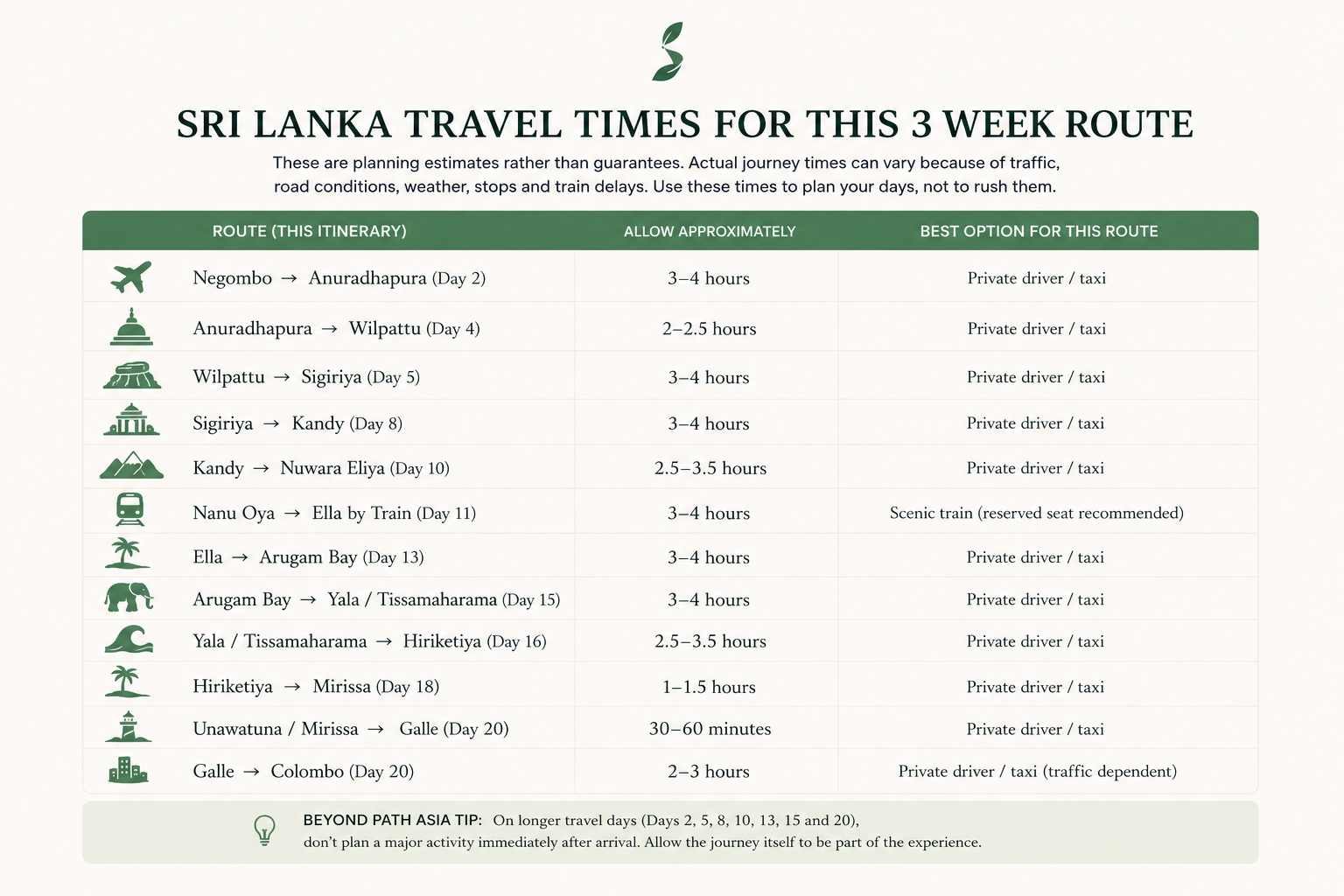
Sri Lanka travel times for this 3 week route
This itinerary covers a large part of Sri Lanka, and some travel days are longer than they may appear on the map. As a planning guide, allow approximately 3–4 hours from Negombo to Anuradhapura, around 2 hours from Anuradhapura to Wilpattu, 3–4 hours from Wilpattu to Sigiriya and around 3–4 hours from Sigiriya to Kandy by road. In the hill country, distances become even more deceptive. Allow around 2.5–3.5 hours from Kandy to Nuwara Eliya by road, while the scenic train journey from Nanu Oya to Ella typically takes around 3–4 hours, depending on the service and delays.
The longest transfer in this itinerary is Ella to Arugam Bay, so allow roughly 3–4 hours and treat it as a travel day rather than planning a full afternoon of sightseeing. From Arugam Bay to the Yala/Tissamaharama area, allow approximately 3–4 hours, followed by around 2.5–3.5 hours from Yala to Hiriketiya. Along the south coast, journeys become shorter. Hiriketiya to Mirissa takes roughly 1–1.5 hours, while Unawatuna is farther west. From the Galle area, allow approximately 2–3 hours to Colombo in normal conditions.
These are planning estimates rather than guarantees. Sri Lankan journey times can vary considerably because of traffic, road conditions, weather, stops and train delays. For this itinerary, don't plan a major activity immediately after every long transfer. On Days 2, 5, 8, 10, 13, 15 and 20, treat the journey itself as part of the day's itinerary.
Beyond Path Asia tip: If you're using public transport instead of private transfers, allow more time and avoid planning tight connections. Sri Lanka is much more enjoyable when you leave some flexibility in your travel days.
Should you follow all 21 days exactly?
No. This is deliberately an ultimate route, not a checklist that every traveller should follow exactly. If you want a slower trip, these are the first places we'd consider changing:
Skip Wilpattu if one safari is enough for you.
Skip Arugam Bay if you're travelling outside the main east-coast season.
Skip Polonnaruwa if you've had enough archaeology after Anuradhapura, Sigiriya and Dambulla.
Use those nights for Ella, the south coast or simply doing less. That's usually a better use of extra time than adding another destination.
What we would do with extra time
Even with more than three weeks, we wouldn't immediately add more destinations. We'd use the extra days to slow this route down.
Our first choices would be:
another night in Ella for hiking
another full beach day
an extra slow day around the Cultural Triangle
And depending on the season, we'd choose either more east coast or more south coast, rather than trying to divide additional time equally between both. Three weeks feels generous until you start moving around Sri Lanka. Then you realise how valuable a completely empty day can be.
How much does a 3 week Sri Lanka trip cost?
Three weeks in Sri Lanka can work across very different travel styles. Locally run guesthouses, public transport and Sri Lankan restaurants can keep costs relatively low, while private drivers, multiple safaris, boutique hotels and luxury resorts increase the total considerably. For this particular itinerary, transport and wildlife experiences are likely to be two of the biggest variables because the route covers a large part of the island and potentially includes two safari regions. Rather than relying on a fixed three-week total that can quickly become outdated, decide first how you want to travel and which experiences are worth spending more on. Read our complete Sri Lanka Budget Travel Guide for a detailed breakdown of accommodation, transport, food, safaris and activity costs.
FAQ about this 3 week Sri Lanka itinerary
-
Definitely not.
Three weeks is an excellent amount of time for a first trip because Sri Lanka has far more regional variety than its size suggests. The additional time also means you don't have to move hotels every day. If you prefer particularly slow travel, simplify this route by removing Wilpattu or Arugam Bay and spend longer in the destinations that remain.
-
For most travellers, no — but it isn't a pure slow-travel itinerary either. You're covering a large part of the island and changing accommodation regularly during some sections.
If you dislike frequent travel days, we'd remove either Wilpattu or Arugam Bay and redistribute those nights between Ella and the south coast.
-
Only if the season and your travel style make it worthwhile. During the main east-coast season, Arugam Bay is a logical addition.
During the main south-coast season, we'd usually prefer spending those two nights farther south rather than travelling all the way east simply to complete the itinerary.
-
Not necessarily. Wilpattu and Yala offer different landscapes and safari experiences, which is why both can work in a three-week itinerary.
If wildlife is one of your main interests, keep both. If you mainly want to experience one Sri Lankan national park, choose a single safari and use the extra night elsewhere.
Our Sri Lanka Safari Guide compares the major parks and can help you choose.
-
Yes, but we'd simplify it slightly for younger children.
Two safaris, multiple cultural sites and several hotel changes can become tiring even when each individual experience is family-friendly.
For families, we'd consider choosing one safari, adding another night in Ella and keeping at least two completely relaxed beach days.
Private transfers also make the Cultural Triangle and coastal sections considerably easier with children.
Read our complete Sri Lanka with Kids Guide for family-specific advice.
-
A combination usually works best.
Use the train through the hill country, where the journey itself is one of the highlights, and combine it with private drivers, taxis or other transport where public transport would consume too much of the day. Buses and trains can reduce costs considerably if you have more flexibility.
Another option is travelling part or all of the route by tuk-tuk, although that requires more time and a different approach to the itinerary. Planning to drive yourself? Read our 2 Week Sri Lanka Tuk Tuk Road Trip before deciding whether that travel style suits you.
-
If you want a reserved seat, yes.
Official Sri Lanka Railways reserved-seat bookings currently open 30 days before travel, and popular hill-country services can sell out quickly after reservations become available.
Check the official timetable and reservation system before your trip because schedules and booking arrangements can change.
Final thoughts on the ultimate 3 week Sri Lanka itinerary
Three weeks gives Sri Lanka something shorter itineraries can't: breathing room. You can experience the ancient cities and hill country without rushing, add two very different safari experiences and still have time to slow down on both the east and south coasts.
You could easily adapt this route to your own travel style. Spend longer in Arugam Bay if you surf, add another night in Ella for hiking, or trade one of the safari stops for extra beach time. The route is a framework rather than a checklist. However you adapt it, 21 days is enough to experience just how varied Sri Lanka really is — and still leave with places you'll want to return to.
Continue planning your Sri Lanka adventure
Ready to turn your route into a real trip? These guides will help with the details:
Sri Lanka Travel Tips — Essential advice for planning and travelling around the island.
Sri Lanka Safari Guide — Compare Yala, Wilpattu, Udawalawe, Minneriya and more.
Sri Lanka Cultural Triangle Guide — Plan the ancient-city part of your journey.
Kandy to Ella Train Guide — Tickets, seats and everything you need to know about the famous train journey.
Sri Lanka South Coast Guide — Choose the best beaches and coastal stops.
Travelling for less time? Explore our 7 Day or 2 Week Sri Lanka Itinerary.
More Sri Lanka inspiration