Sri Lanka with kids: The ultimate family travel guide
Sri Lanka is one of the most varied family destinations in Asia. In a single trip, your children can climb an ancient rock fortress, search for elephants on safari, travel through tea-covered mountains by train, learn to surf and finish the journey beside a tropical beach. That variety is exactly what makes Sri Lanka work so well with kids. The key is not trying to do too much.
Travel times are often longer than they appear on the map, the heat can make sightseeing tiring and children usually enjoy the trip much more when every day isn't packed from morning until evening. For most families, the best approach is simple: choose fewer destinations, stay longer and alternate active days with slower ones. Below you'll find the best places to visit, family-friendly safari and beach choices, practical transport advice and a realistic 2 week Sri Lanka family itinerary.
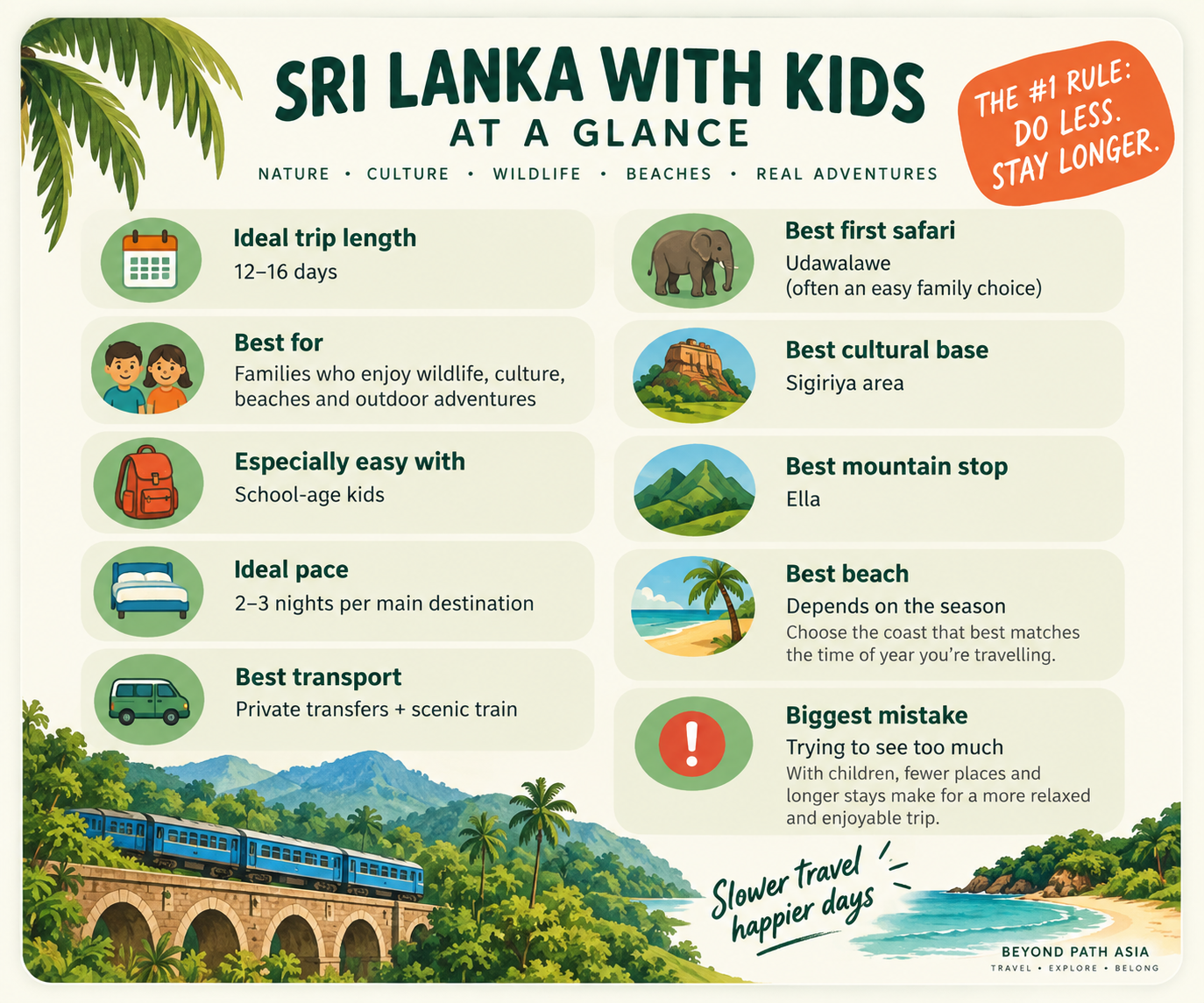
Sri Lanka with kids at a glance
Is Sri Lanka good for families?
Yes. Sri Lanka works particularly well for families who prefer experiences over traditional sightseeing. The trip constantly changes. A few days of ancient temples and fortresses can be followed by a safari. After that, you're travelling through the mountains by train. Then suddenly you're beside the ocean. That variety keeps the journey interesting without needing dedicated children's attractions every day. For a first family trip, we'd prioritise four experiences:
Sigiriya area → Kandy → scenic train → Ella → one safari → beach
Everything else is optional. Kandy fits naturally into the route, while places such as Anuradhapura, Polonnaruwa, Nuwara Eliya or a second safari should only be added if they genuinely match your family's interests. The challenge in Sri Lanka isn't finding enough to do. It's knowing when to stop.
What is the best age to visit Sri Lanka?
There isn't one perfect age. Sri Lanka can work with babies, toddlers, school-age children and teenagers, but the itinerary should change accordingly.
Babies & Toddlers - Sri Lanka is possible with babies and toddlers, but we'd simplify the route significantly. Reduce hotel changes, use private transfers strategically and choose accommodation where you can easily return for food, shade or rest during the hottest part of the day. We wouldn't try to follow the same itinerary you'd choose with older children. Fewer destinations usually means a much easier trip.
Ages 6–14 - This is arguably the easiest age range for Sri Lanka. Children are old enough to enjoy climbing Sigiriya, spotting animals on safari and travelling by train, while tuk-tuks, monkeys and coconuts beside the road can still feel genuinely exciting. Most of the country's major experiences are accessible without every day becoming too demanding.
Teenagers - Sri Lanka works especially well for active teenagers. Surfing, hiking, kayaking, cycling, wildlife photography and cooking classes can all add more independence to the trip. It can also help to let teenagers choose some activities themselves rather than filling the route entirely with sightseeing.
So what's the best age? - There's no perfect age for Sri Lanka. School-age children can participate in many of the country's signature experiences, but pace and route planning matter far more than age alone.
How long do you need in Sri Lanka with kids?
For most families, we'd aim for around two weeks. One week is possible, but you'll need to be selective. Three weeks is excellent if you want more beach time, slower travel or a second region. A useful way to think about it is:
7 days — choose 3–4 main areas
14 days — culture + mountains + safari + beach
21 days — slower journey with more downtime
With children, don't use extra days simply to add destinations. Use them to stay longer.
Best places to visit in Sri Lanka with kids
For a first family trip, we'd focus on destinations where the experience itself is engaging rather than trying to visit every famous stop.
1. Sigiriya & the Cultural Triangle
If we had to choose one cultural base for families, it would be the Sigiriya area. It combines history, climbing, temples, wildlife and enough good accommodation to make slower afternoons easy.
Sigiriya Rock Fortress - Sigiriya turns sightseeing into an adventure. Children climb through gardens, staircases and the famous Lion's Paw before reaching the remains of the ancient palace at the summit. Start early. The climb becomes much harder once the heat builds. For younger children, don't make reaching the summit the only measure of success. The lower sections are still worthwhile.
Pidurangala - Pidurangala offers spectacular views towards Sigiriya but isn't simply an easier alternative. The final section requires scrambling over rocks. We'd reserve it for confident older children.
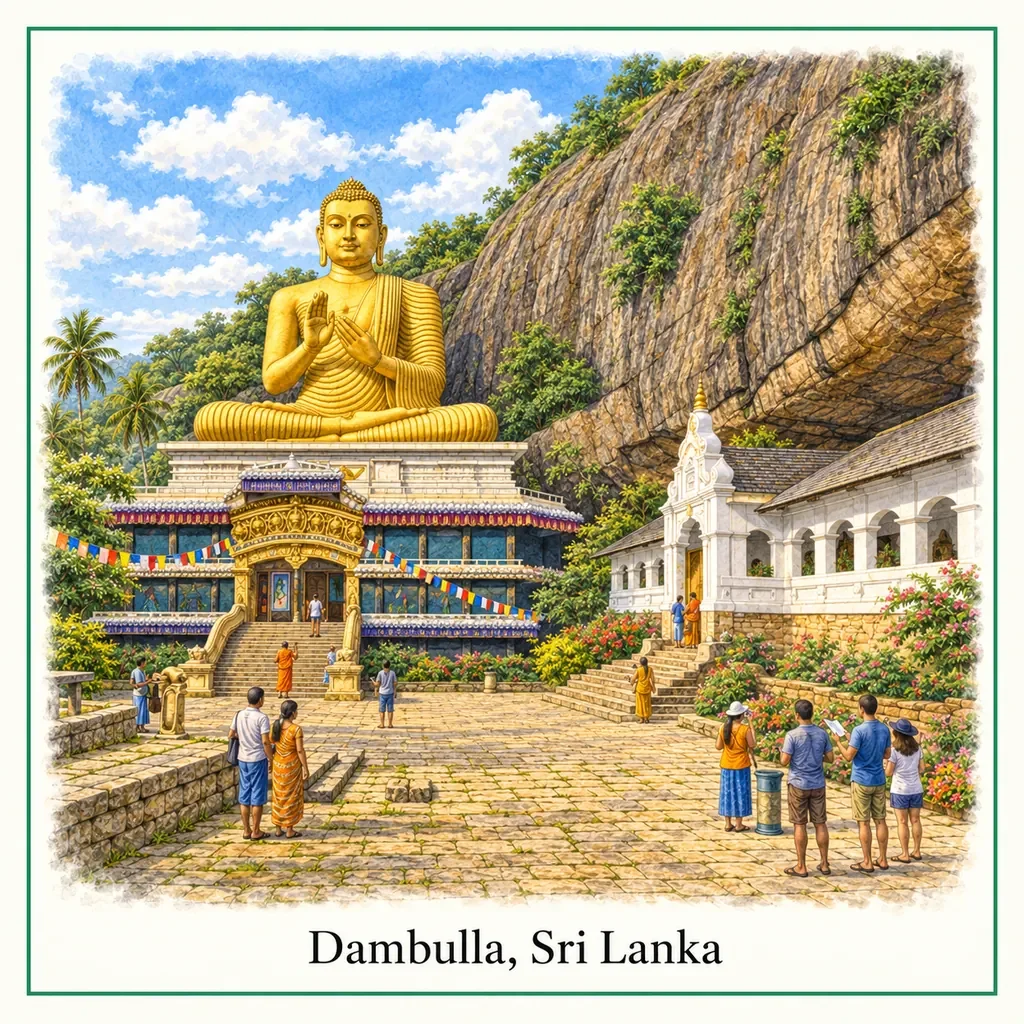
Dambulla Cave Temple - Dambulla gives you something completely different. Instead of another enormous archaeological site, children enter a series of cave shrines filled with Buddha statues and colourful paintings. It's relatively compact and easy to combine with another activity.
Polonnaruwa or Anuradhapura? - With children, we wouldn't automatically include both. If you want one additional ancient city, Polonnaruwa is often the easier family option because the main archaeological zone is more compact and works well by bicycle or tuk-tuk. Anuradhapura is fascinating but more spread out.
How Long Should Families Stay? We'd aim for 3 nights around Sigiriya if possible. That gives you time for one major activity each morning and enough breathing room afterwards. Read our Sri Lanka Cultural Triangle Guide before deciding which sites to include.
2. Kandy
Kandy makes sense because it sits naturally between the Cultural Triangle and the hill country. The Temple of the Sacred Tooth Relic offers an important cultural experience, while the Royal Botanic Gardens at Peradeniya provide more space and a completely different pace. But we don't think Kandy needs to become the centre of the family itinerary. For most families: 1–2 nights is enough. Use it as a bridge between the ancient sites and the mountains.
3. Ella & the Hill Country
Ella is one of the strongest stops in a Sri Lanka family itinerary. After several days of culture, the cooler mountain air and outdoor activities provide a welcome change. Good family experiences include: Little Adam's Peak, Nine Arch Bridge, waterfalls, tea experiences, cooking classes and simply spending time in cafés overlooking the mountains. Little Adam's Peak is particularly useful because children get the feeling of completing a real mountain walk without committing to a full-day hike. We'd stay at least 2 nights. Three is even better if your itinerary allows it.
The Hill-Country train with kids - The scenic train through Sri Lanka's hill country is one of the experiences we'd actively build into a family trip. Tea plantations, tunnels, stations and changing mountain scenery make the journey much more engaging than a normal road transfer. But plan it properly. Popular trains can be busy and delays happen. If you want a reserved seat, check the official booking system when the reservation window opens. Reserved seats are currently released 30 days before travel through Sri Lanka Railways' official reservation system, although booking procedures can change. With children, reserved seating is worth prioritising where available. And don't encourage children to lean or hang from open train doors for photographs. Read our Kandy to Ella Train Guide before booking.
Should families stay in Nuwara Eliya? - Only if it adds something important to your trip. Nuwara Eliya gives you a stronger tea-country experience and cooler weather, but it can also mean another hotel change. For a first family itinerary, we'd generally choose: Kandy → train → Ella and only add Nuwara Eliya if tea estates or the highlands are a major priority. With children, simplifying the route often improves the trip more than adding one extra destination.
Best safari in Sri Lanka with kids
A safari is often one of the biggest highlights for children. But you don't need several. For most families, we'd choose one good safari.
Udawalawe - If elephants are your main priority, Udawalawe is one of the easiest family choices. The landscape is relatively open and elephants are frequently encountered, although wildlife can never be guaranteed. A half-day safari also fits naturally into a family itinerary.
Yala - Choose Yala if older children are genuinely excited about searching for wildlife and the possibility of seeing a leopard. Research in Yala's Block I has recorded exceptionally high leopard densities, but sightings are never guaranteed. Yala can also become busy. We wouldn't choose it automatically simply because it's the most famous park.
Minneriya & Kaudulla - These parks work particularly well if you're already staying around Sigiriya. Elephants move between the parks and surrounding areas according to rainfall and water levels, so ask a reputable operator which location is currently better.
Wilpattu - Wilpattu offers a more forested and often quieter safari experience. It suits families with older children who enjoy wildlife enough to appreciate the search itself.
Which safari would we choose?
Families prioritising elephants + a relatively straightforward safari → Udawalawe
Already staying around Sigiriya → Minneriya or Kaudulla
Older wildlife-focused children → Yala
Quieter wilderness experience → Wilpattu
Read our complete Sri Lanka Safari Guide before choosing.
How long should a safari be with children?
For most families, we'd start with a half-day safari rather than a full day. Several hours in an open jeep can already be tiring for younger children, and a shorter safari usually gives you plenty of time to enjoy the wildlife without pushing their attention span too far. Bring water, snacks, sun protection and binoculars if you have them. It also helps to turn the safari into a game. Count elephants, monkeys, crocodiles, buffalo and birds rather than spending the entire drive waiting for one famous animal.
Best beaches in Sri Lanka for families
The beach section should usually become the slowest part of the trip. After temples, transfers, trains and safari jeeps, staying several nights in one place can completely change how the holiday feels. But choose the beach according to the season.
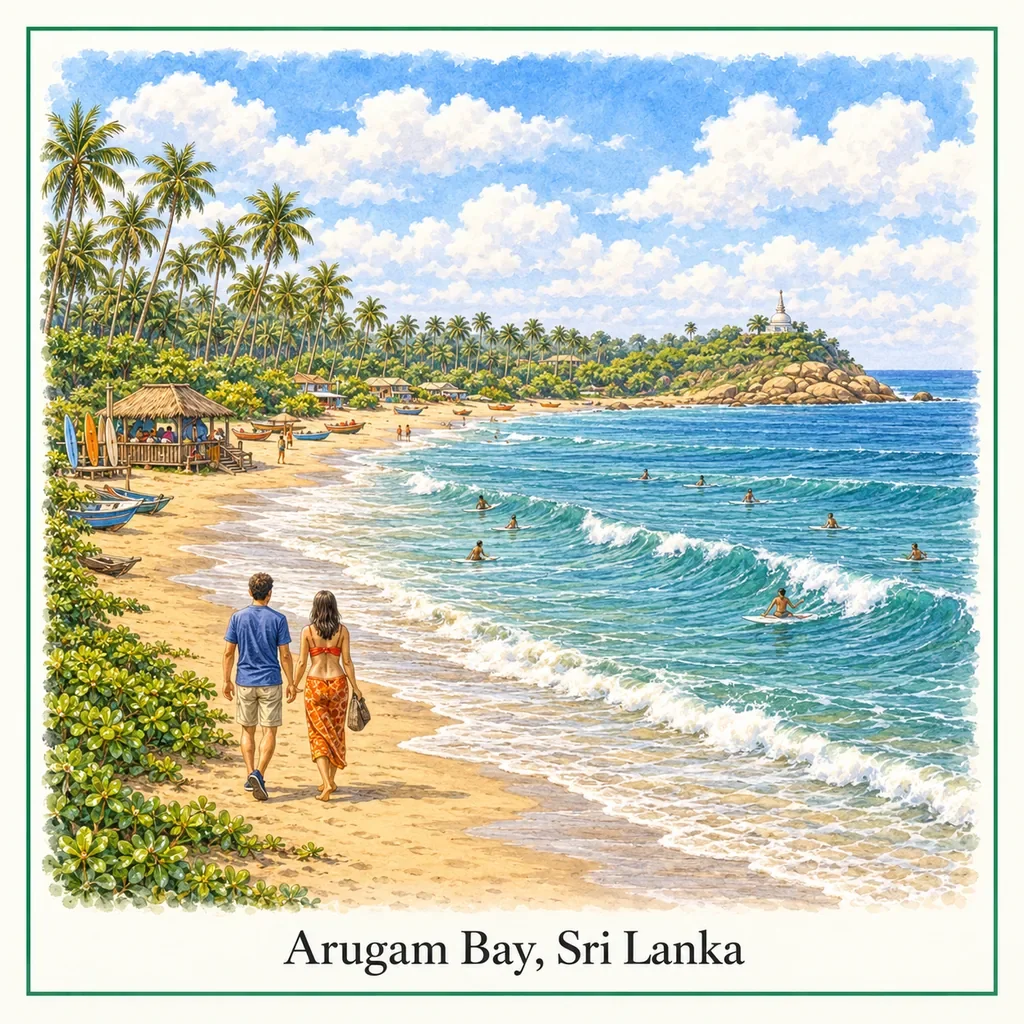
Weligama - Weligama is particularly useful for families interested in beginner surfing. The broad bay has plenty of surf schools, restaurants and accommodation. Sea conditions still vary, so always check locally before children enter the water.
Mirissa - Choose Mirissa if you want a livelier beach town with plenty of restaurants and optional seasonal whale watching. It's easy to combine with Weligama and Galle.
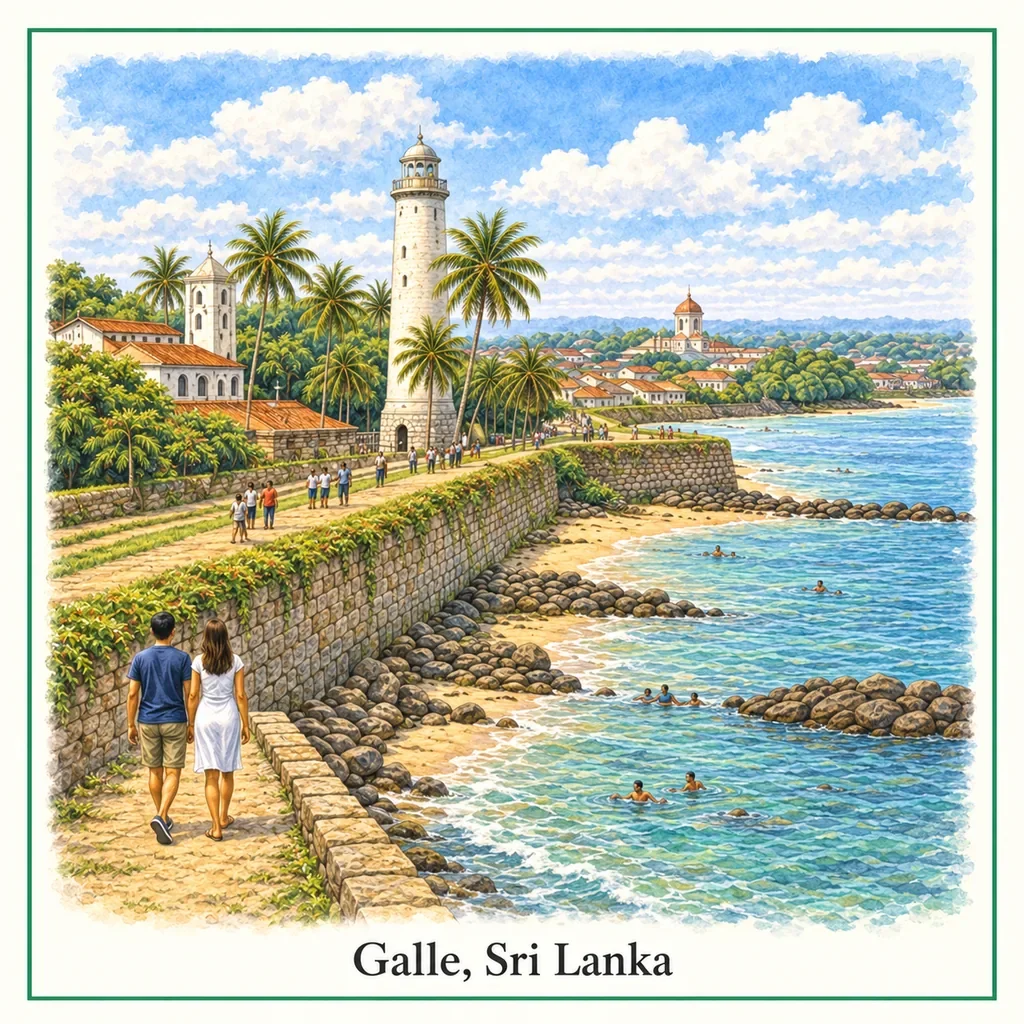
Unawatuna - Unawatuna works well if you want beach time combined with easy access to Galle Fort. It's also practical because of the large selection of hotels and restaurants.
Tangalle - Tangalle is a stronger choice if your priority is a quieter resort finish. Individual beaches can have strong waves and currents, so always check local conditions.
Trincomalee & Nilaveli - During the main east-coast season, Trincomalee and Nilaveli can make much more sense than forcing the south coast into your route.
Which beach would we choose?
Surf lessons → Weligama
Lively beach town → Mirissa
Galle + beach → Unawatuna
Quieter resort stay → Tangalle
East-coast season → Trincomalee/Nilaveli
Read our Sri Lanka South Coast Guide before deciding where to stay.
Getting around Sri Lanka with kids
Private transfers
Useful for airports and longer road days. Confirm vehicle size, luggage capacity and suitable child restraints in advance. Agree stops for food, toilets and breaks rather than planning around the shortest map estimate.
A scenic train section
Check current operations first: the hill-country line has reopened in stages after storm damage, so do not assume a through Kandy–Ella service is available. A shorter operating section may be more manageable. Read our train guide before booking.
Tuk-tuks
Assess passenger limits, seating and restraints, weather exposure and luggage space before choosing one for your family. A self-drive road trip also requires the correct authorisation and insurance. Compare the options in our tuk-tuk guide.
Family travel times in Sri Lanka
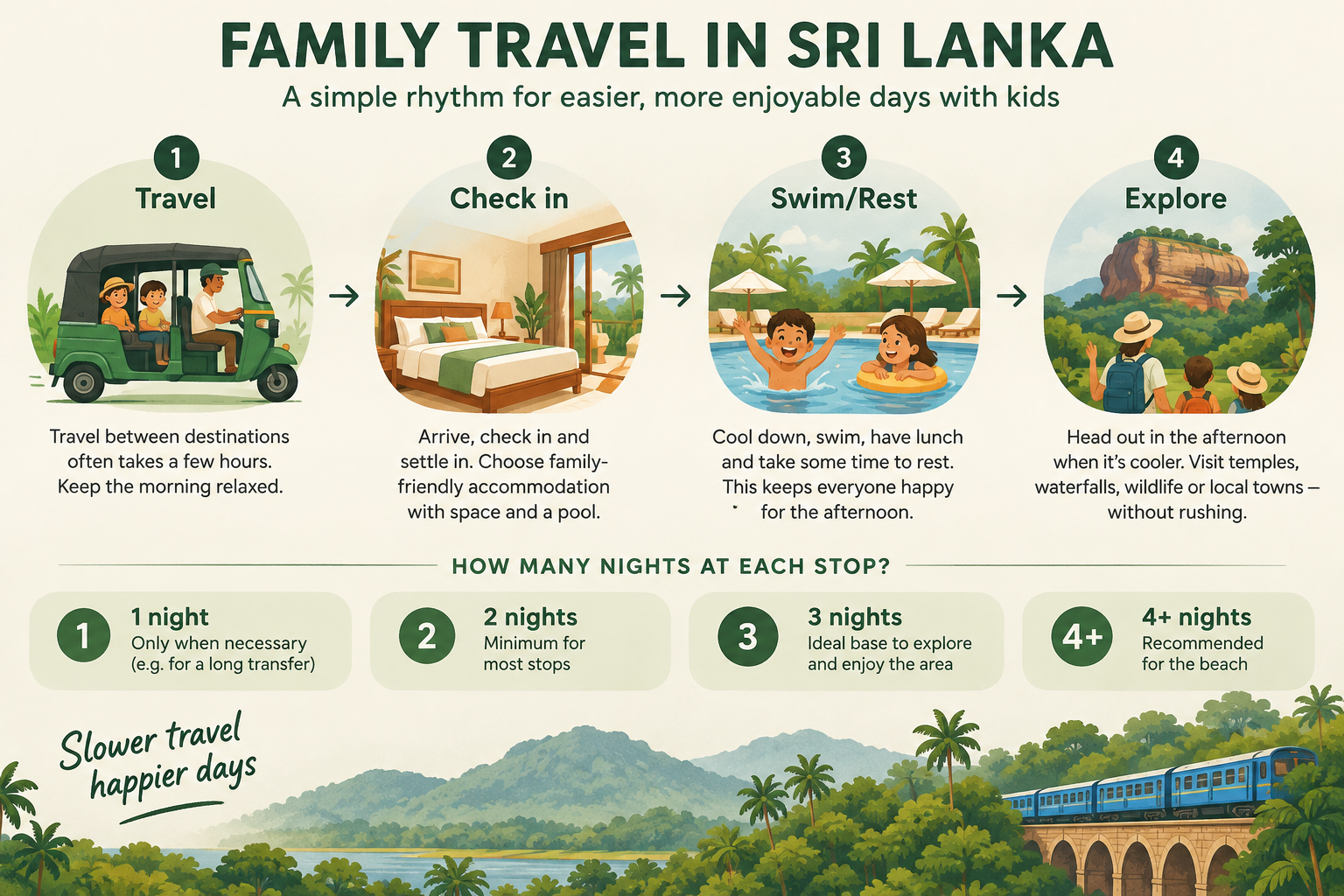
Sri Lanka is geographically compact but journeys can still take several hours. This is one of the easiest things to underestimate when travelling with children. Our preferred rhythm is: travel → check in → lunch or swim → decide later whether you still want another activity. Avoid building important timed attractions directly after a long transfer. We'd also avoid changing hotels every night. For families, a useful rule is:
Where to stay in Sri Lanka with kids
Prioritise location, sleeping arrangements and easy access to meals. Confirm maximum occupancy, children’s ages, connecting-room availability, extra-bed charges and pool access directly before booking.
The properties below are options to compare at different stages of the route. Check the actual room type rather than assuming a hotel’s family label covers your group, especially when travelling with several children.
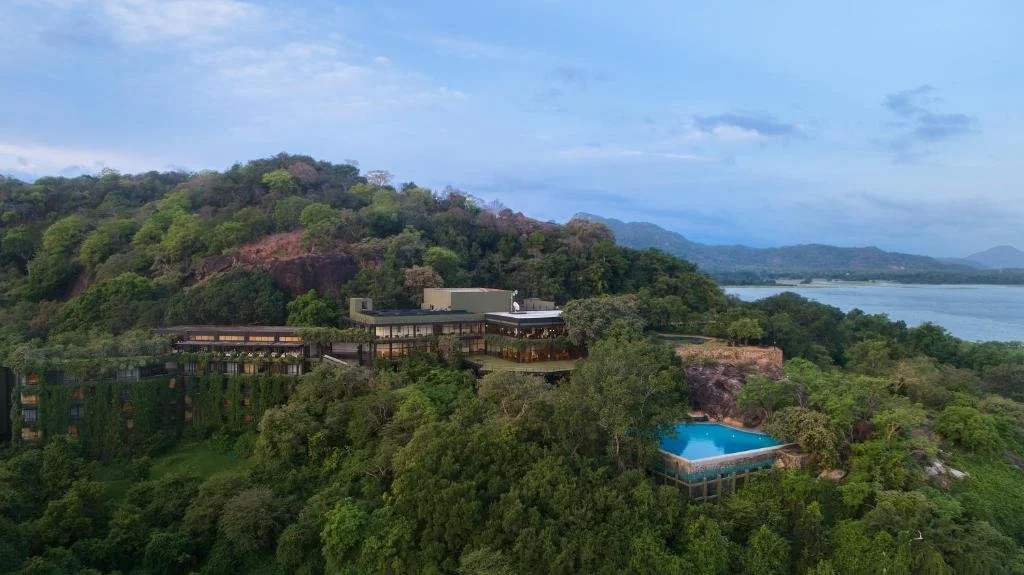
Cultural Triangle – Heritance Kandalama
If you're exploring Sigiriya, Dambulla and Minneriya National Park, Heritance Kandalama is hard to beat. Designed by Sri Lanka's famous architect Geoffrey Bawa, the hotel blends seamlessly into the surrounding jungle and overlooks the peaceful Kandalama Lake. Monkeys regularly wander through the gardens, colourful birds are everywhere and the infinity pools offer spectacular views across the forest. Families love the spacious rooms, multiple swimming pools and convenient location. Most of the Cultural Triangle's major attractions are less than an hour away, meaning you spend less time driving and more time exploring. After an early morning climb up Sigiriya Rock or an afternoon safari, returning to the hotel for a swim while watching the sunset over the lake is the perfect way to end the day.
👉Check availability & prices at Heritance Kandalama
Why we'd choose it for families - It feels like staying inside nature without giving up any comfort. The gardens, pools and wildlife around the property give families plenty to enjoy between sightseeing days.
➡️ Planning your route? Our Sri Lanka's Cultural Triangle Guide shows exactly how to combine Heritance Kandalama with Sigiriya, Dambulla and nearby safari parks.
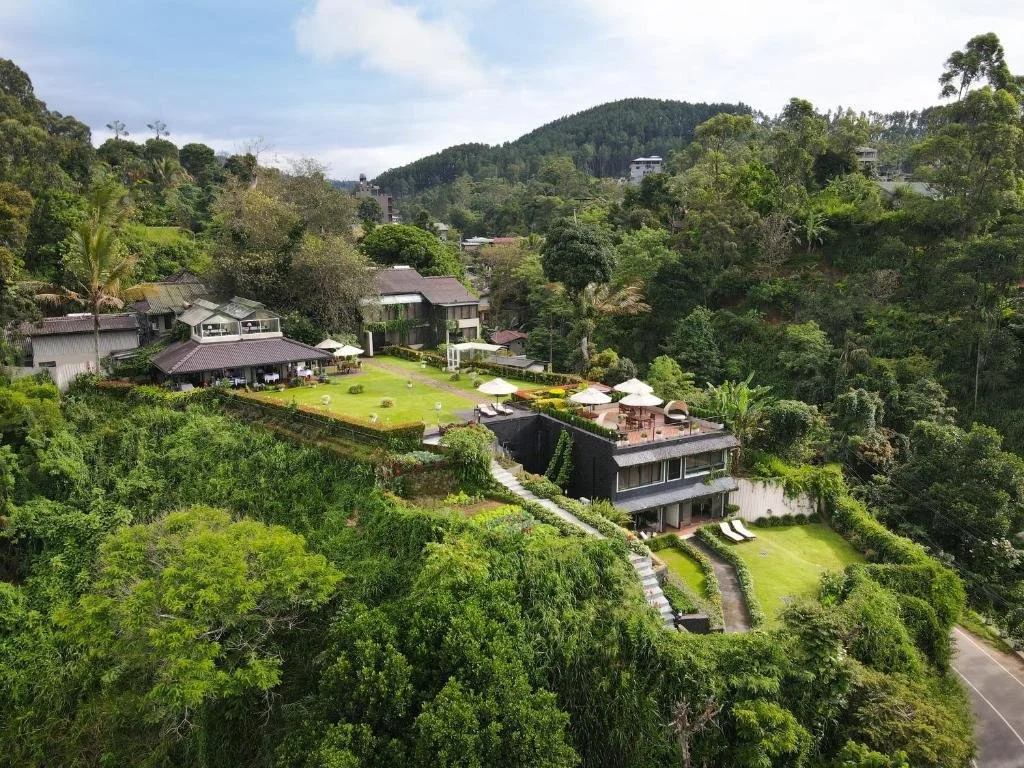
Hill Country – EKHO Ella
EKHO Ella works particularly well for families who want mountain views without staying far outside town. Its location makes cafés and restaurants easier to reach, while several of Ella's main sights are only a short transfer away. Perched on the edge of Ella's famous hills, the hotel offers panoramic views across the valley while remaining within walking distance of cafés, restaurants and the town centre. This means parents don't have to rely on taxis every time they want dinner, while children can enjoy the lively atmosphere after a day of sightseeing. Nearby attractions such as Nine Arch Bridge, Little Adam's Peak and Ravana Falls are all easy day trips, making EKHO Ella an excellent base for exploring the region.
👉Check availability & prices atEKHO Ella
Why we'd choose it for families - Why we'd choose it for families — The central location makes exploring Ella much easier with children, while the mountain views still give you the feeling of staying in Sri Lanka's hill country. The central location also makes exploring Ella incredibly easy with children.
➡️ Don't miss our Ultimate Guide to the Kandy to Ella train ride, one of the highlights of any family trip.
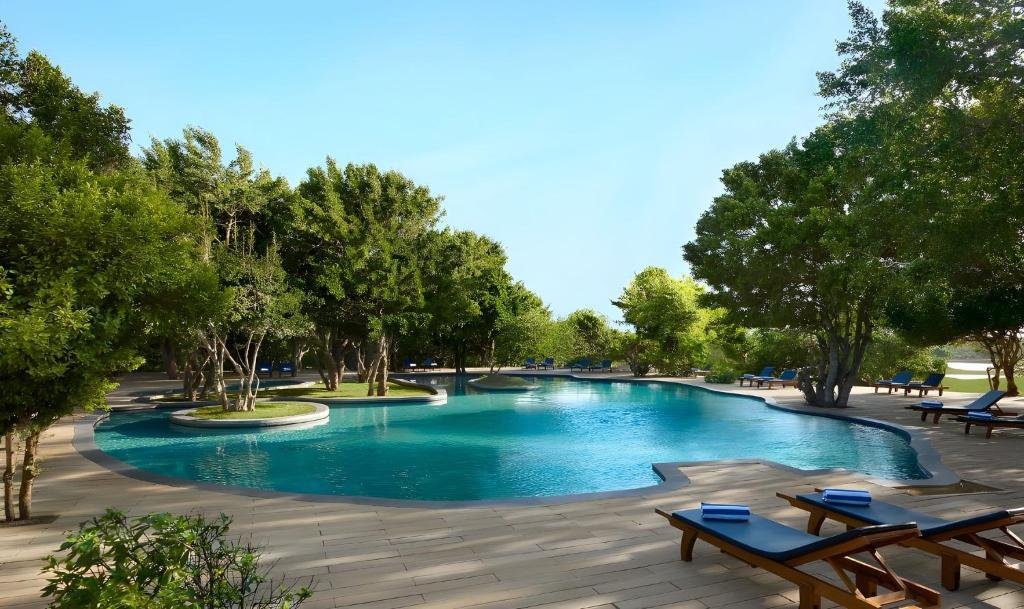
Safari – Cinnamon Wild Yala
If your children are excited about seeing elephants, crocodiles and perhaps even a leopard, Cinnamon Wild Yala is a fantastic place to stay. Located just outside the entrance to Yala National Park, the hotel is surrounded by nature, and it's not unusual to spot peacocks, wild boar, monkeys or even elephants wandering nearby. The spacious grounds and swimming pool make it a relaxing place to return to after an early morning safari, while the location allows families to reach the park before most other visitors arrive.
👉Check availability & prices atCinnamon Wild Yala
Why we'd choose it for families - The gardens, wildlife and pools mean the hotel offers plenty to do between sightseeing days. Wildlife isn't limited to the safari—you often start spotting animals before you even leave the hotel.
➡️ Read our Ultimate Sri Lanka Safari Guide to find out whether Yala, Udawalawe or Minneriya is the best choice for your family.
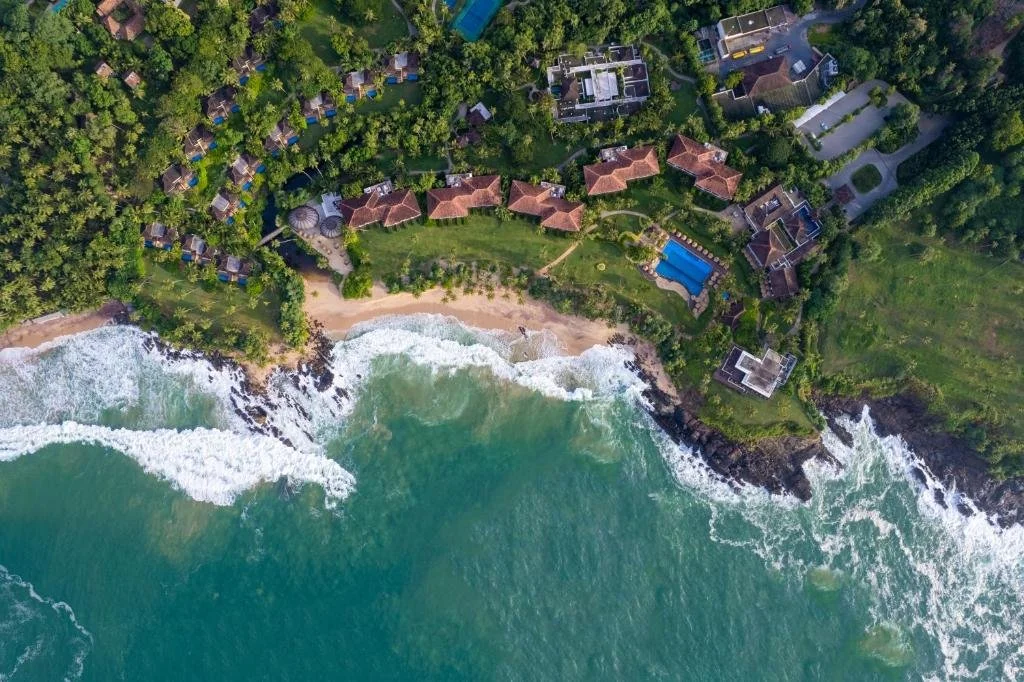
South Coast – Anantara Peace Haven Tangalle Resort
After days filled with adventure, there's no better place to slow down than Anantara Peace Haven Tangalle Resort. Set on a quiet stretch of coastline surrounded by palm trees, the resort offers spacious family rooms, beautiful gardens, several restaurants and one of the best swimming pools on the south coast. Children can join organised activities or spend hours in the pool, while parents relax in the spa or enjoy dinner overlooking the Indian Ocean. Nearby beaches, turtle conservation projects and whale-watching excursions provide plenty of opportunities for family adventures beyond the resort.
👉Check availability & prices atAnantara Peace Haven Tangalle Resort
Why we'd choose it for families - After a busy journey through the Cultural Triangle, hill country and safari areas, the pools, spacious grounds and beach setting make it particularly easy to slow the pace for the final few days.
➡️ Continue exploring with our South Coast Travel Guide, where we share the best beaches, cafés and hidden coastal gems.
Sri Lankan food with kids
Sri Lankan food is often easier with children than parents expect. Not every dish is extremely spicy, and tourist areas generally offer familiar alternatives too. Family-friendly foods can include rice, dhal, hoppers, string hoppers, roti, eggs, fresh fruit and mild curries. Kottu roti can also be an easy introduction to Sri Lankan flavours. If your children are sensitive to chilli, ask whether dishes can be prepared mild. Fresh fruit is particularly useful as an easy snack. Mango, banana, pineapple, watermelon and coconut are widely available depending on the season.
Travelling with vegetarian children?
Sri Lanka is one of the easier destinations in Asia for vegetarian families. Dhal and vegetable curries give you plenty of choice. Be aware that Maldive fish can sometimes appear in sambols and dishes that otherwise look vegetarian. Our Vegetarian Food in Sri Lanka Guide explains what to order.
How much does a family trip to Sri Lanka cost?
There isn't one useful daily figure for every family. Your total depends heavily on accommodation, transport and how many paid experiences you include. The biggest family budget decisions are usually accommodation, private transport, safaris and major attractions. Family rooms and connecting rooms can also affect the total more than they would for couples. Instead of publishing a fixed family budget here that will quickly become outdated, use our Sri Lanka Travel Budget Guide to estimate costs according to your travel style.
A two-week family route to adapt
This example covers 13 nights and 14 days. It suits a trip combining the Cultural Triangle, hill country, one safari and a south-coast finish; change the beach section for your travel season.
Day 1: Negombo, one night. Recover after the flight and keep plans light.
Days 2–4: Sigiriya area, three nights. Choose two or three outings rather than every ancient site. Leave pool or rest time.
Day 5: Kandy, one night. Treat this as a transition and choose one main activity if timing allows.
Days 6–8: Ella, three nights. Travel by road or combine a road transfer with a confirmed operating train section. Keep arrival day relaxed.
Day 9: Udawalawe, one night. Arrive before your safari day and confirm pickup.
Days 10–13: one coastal base, four nights. Take a morning safari on day 10 only if the onward drive remains manageable, then slow down at the coast.
Day 14: departure. Allow a generous airport-transfer buffer. For an early flight, move the final night closer to the airport instead of driving overnight.
For younger children, reduce the number of bases or skip an extra activity. Use our detailed family itinerary as a starting point and check current transport before committing.
Practical tips for Sri Lanka with kids
Keep major sightseeing for the cooler morning hours and use the middle of the day for lunch, swimming or rest. Carry water and easy snacks on long transfers. Keep temple-appropriate clothing accessible instead of buried at the bottom of your luggage. Pack one warmer layer for the hill country. Where possible, reserve train seats in advance and choose accommodation with pools strategically rather than at every stop. Most importantly, don't schedule every afternoon. A family day isn't more successful because you completed more attractions.
Common mistakes when visiting Sri Lanka with kids
Following an adult-paced itinerary - Five destinations may be better than eight. Reducing hotel changes is one of the easiest ways to improve the trip.
Underestimating travel times - Short distances can still take several hours. Don't plan around the fastest possible map estimate.
Visiting too many cultural sites - Children who loved Sigiriya may still have had enough archaeology by the third ancient city. Choose variety over completeness.
Booking multiple safaris - For most families, one good safari is enough. Add a second only if wildlife is genuinely one of your main interests.
Choosing the beach without checking the season - The right coast depends on your travel dates. Don't automatically build every itinerary around the south.
Treating downtime as wasted time - A pool afternoon isn't a gap in the itinerary. It's part of what makes the itinerary sustainable.
Choosing hotels only by price - A cheaper hotel that adds another hour of driving can be poor value for a family. Location matters.
Frequently asked questions about Sri Lanka with kids
-
Yes. Many families travel to Sri Lanka with very young children and have a wonderful experience. If you're travelling with babies or toddlers, we recommend moving at a slower pace, choosing family-friendly hotels with swimming pools and limiting long travel days. Hiring a private driver also makes travelling much more comfortable, as you can stop whenever needed.
-
There isn't a perfect age, but children between six and twelve often get the most out of the island's mix of wildlife, adventure and culture. That said, teenagers love the surfing, hiking and safaris, while toddlers can enjoy the beaches, nature and welcoming atmosphere just as much.
-
For first-time visitors, we recommend two weeks. This gives you enough time to experience the Cultural Triangle, Hill Country, a safari and the South Coast without feeling rushed. If you have three weeks, you'll be able to travel at a slower pace and explore some of Sri Lanka's lesser-known regions.
-
Compared with many other long-haul destinations, Sri Lanka offers excellent value for money. Accommodation, food and transport are generally affordable, especially outside the luxury segment. Families can choose everything from budget guesthouses to world-class resorts, making it easy to plan a trip that fits different budgets.
For a full cost breakdown, read our Sri Lanka Budget Travel Guide.
-
Absolutely. Safaris are often the highlight of a family holiday. Parks such as Udawalawe and Minneriya offer excellent chances of seeing elephants, while older children may enjoy searching for leopards in Yala National Park. Morning safaris are usually the best option, as wildlife is more active and temperatures are cooler.
-
For most families, yes. A private driver offers flexibility, comfort and convenience that can make the entire trip much more enjoyable. It also allows you to stop at scenic viewpoints, cafés or attractions along the way without worrying about bus schedules or navigating unfamiliar roads.
-
For adventurous families with older children, renting a tuk tuk can be an unforgettable experience. It offers complete freedom to explore at your own pace and creates a genuine sense of adventure. However, if you're travelling with very young children or prefer maximum comfort, a private driver is usually the better option.
-
There isn't one Sri Lankan beach that is always the safest choice for families. Sea conditions vary by beach, season and even by day. Choose your coast according to the season, ask locally about currents and swimming conditions, and supervise children closely around the ocean.
-
Yes. The Kandy to Ella train can be one of the highlights of a Sri Lanka family trip, especially for school-age children who enjoy watching the mountains, tea plantations and small stations pass by. We recommend booking reserved seats where possible and bringing water, snacks and something to keep younger children occupied during the long journey. Keep children supervised and safely inside the carriage rather than allowing them to lean or hang from open doors. Sri Lanka Railways allows children on reserved services; its current policy states that children aged 3 and over pay the full fare, while younger children can travel free when sharing a parent's seat.
-
Yes. Sri Lanka is particularly well suited to families who enjoy wildlife, beaches, outdoor activities and cultural experiences. The main challenge isn't finding enough to do, but avoiding an itinerary with too many hotel changes and long travel days.
Final thoughts: is Sri Lanka worth visiting with kids?
Absolutely. But don't try to experience it at adult speed. The magic of a Sri Lanka family trip is the variety. Climbing towards the top of Sigiriya. Counting tunnels from a train window. Watching an elephant disappear into the grass. Trying a hopper for breakfast. Learning to surf. Jumping into a hotel pool after a hot morning exploring temples. Then eventually reaching the coast with nowhere else you need to be. Choose fewer places. Stay longer. Mix adventure with rest. And give your children enough time to experience Sri Lanka rather than simply travelling through it.
Continue planning your Sri Lanka family adventure
2 Week Sri Lanka Itinerary - Use our main route as a starting point and adapt the pace to your family.
Sri Lanka Travel Tips - Practical advice on weather, transport, money, temples and planning.
Sri Lanka Cultural Triangle Guide - Decide which ancient sites deserve a place in your family itinerary.
Kandy to Ella Train Guide - Plan the hill-country railway journey and understand the current reservation system.
Sri Lanka Safari Guide - Compare the main national parks before choosing your family safari.
Sri Lanka South Coast Guide - Find the beach destination that best matches your travel dates.