The ultimate Sri Lanka safari guide
A Sri Lanka safari can bring you into elephant country, dry-zone forest or reservoir-side wetlands, with very different experiences between parks. Choose according to your route, travel dates and wildlife interests rather than the most familiar name.
This guide compares the main options, explains what to ask before booking and helps you plan a responsible visit. Wildlife sightings are never guaranteed; a rewarding drive also takes in birds, smaller animals and the landscape around them.
Why Sri Lanka is one of the best safari destinations in Asia
When people think about safaris, countries such as Kenya, Tanzania or South Africa usually come to mind first. While those destinations undoubtedly offer spectacular wildlife experiences, Sri Lanka has quietly become one of Asia's greatest safari destinations—and for good reason. The island may be relatively small, but its biodiversity is extraordinary. Within just a few hours' drive, the landscape changes from dry grasslands and dense jungle to misty mountains, tropical wetlands and untouched coastline. Each ecosystem supports different wildlife, meaning every national park offers a unique safari experience.
One of Sri Lanka's greatest strengths is accessibility. Unlike many African safari destinations where visitors often need to fly between reserves or stay in remote lodges for several days, Sri Lanka's parks fit naturally into a broader travel itinerary. You might spend a few days exploring the Cultural Triangle before continuing to Minneriya National Park, ride the scenic train from Kandy to Ella and then head south to Udawalawe or Yala before relaxing on the beaches of Mirissa or Tangalle. This variety is one of the reasons so many travellers fall in love with the country. A safari doesn't feel like a separate holiday—it becomes part of a journey through one of the most diverse destinations in Asia.
Wildlife experiences in Sri Lanka aren't limited to national parks and jeep safaris. For something completely different, explore Sinharaja Forest Reserve, where guided walks take you deep into one of the country's most important tropical rainforests in search of endemic birds, reptiles and other wildlife.
Sri Lanka also offers remarkable value. Compared with many safari destinations around the world, park entrance fees and jeep safaris are relatively affordable, making wildlife experiences accessible to backpackers, families and luxury travellers alike. Whether you choose a shared jeep or a private guide, seeing elephants, crocodiles and colourful birdlife often costs a fraction of what you might expect elsewhere.
What wildlife can you expect to see?
Sri Lanka may be best known for elephants and leopards, but those two animals represent only a small part of the island's incredible biodiversity. More than 120 mammal species and over 450 bird species have been recorded here, many of which are found nowhere else on Earth. Every safari is different. Sometimes the excitement comes from finally spotting a leopard after hours of searching. On another day, it may be an elephant calmly crossing the road just a few metres in front of your jeep or a crocodile lying almost invisible along the edge of a lake. Part of the magic is that nothing is guaranteed. Wildlife moves freely through these protected landscapes, making every safari feel authentic rather than staged.
The Sri Lankan leopard
Few animals capture the imagination quite like the Sri Lankan leopard. As the island's largest predator, it sits at the top of the food chain and has adapted remarkably well to the country's varied landscapes. Unlike leopards in parts of Africa that often live alongside lions, Sri Lankan leopards have no natural predators. This has made them more confident and, in some parks, surprisingly active during daylight hours.
Yala National Park has earned an international reputation for offering one of the highest chances of leopard sightings anywhere in the world. However, that doesn't necessarily mean every visitor will see one. Nature always has the final say, and that's exactly what makes the experience so rewarding. If your dream is to photograph a leopard in the wild, patience is just as important as choosing the right national park.
Asian elephants
For many travellers, elephants become the true stars of a Sri Lanka safari. The country is home to one of the largest populations of wild Asian elephants, with thousands roaming freely across forests, grasslands and reservoirs. Unlike in some destinations where elephant sightings require considerable luck, Sri Lanka offers remarkably consistent opportunities to observe these magnificent animals in their natural environment. Watching a family herd move silently through the landscape is an unforgettable experience. Mothers protect young calves while older juveniles play together, and large bulls occasionally appear on their own, wandering between feeding grounds. The best part is that these encounters happen naturally. There are no feeding shows or artificial attractions inside the national parks—only wild animals behaving exactly as they have done for generations.
Sloth bears
Although far less common than elephants, Sri Lanka's sloth bears are among the country's most fascinating mammals. With their shaggy black coats, pale snouts and distinctive white chest markings, they look completely different from the bears many travellers expect to see. They spend much of their time searching for termites, insects and fruit, often disappearing into dense vegetation long before visitors notice them. Sightings are relatively rare, making them especially memorable for wildlife enthusiasts.
Crocodiles, buffalo and other wildlife
Even when leopards remain hidden, there's rarely a dull moment during a safari. Large mugger crocodiles bask along riverbanks while water buffalo cool themselves in muddy pools. Herds of spotted deer graze in open clearings, grey langurs leap effortlessly through the trees and colourful peacocks seem to appear almost everywhere. If you're lucky, you may even encounter jackals, mongooses, fishing cats or one of Sri Lanka's many endemic reptiles. The diversity is one of the biggest reasons to avoid focusing solely on leopards. Some of the most memorable safari moments come from completely unexpected wildlife encounters.
A paradise for birdwatchers
Even travellers who don't usually consider themselves birdwatchers often find themselves reaching for their cameras. Bright blue kingfishers dart across lakes, crested serpent eagles circle overhead and painted storks gather in shallow wetlands alongside pelicans and spoonbills. During certain seasons, migratory birds arrive from across Asia and Europe, transforming parks such as Bundala into internationally recognised birdwatching destinations.
Bringing a small pair of binoculars can completely change your safari experience. Suddenly you'll begin noticing details that many visitors miss—from tiny bee-eaters perched on branches to owls hidden deep within ancient trees.
Choosing the right safari: there isn't one perfect answer
One of the biggest misconceptions about travelling in Sri Lanka is that everyone should visit Yala National Park. Yala certainly deserves its reputation. It offers outstanding biodiversity, dramatic landscapes and an excellent chance of spotting leopards. But that doesn't automatically make it the best choice for every traveller. If seeing elephants is your main goal, Udawalawe often provides a more rewarding experience. Families with young children usually appreciate its shorter driving distances and reliable wildlife sightings. Travellers looking for a quieter, more remote atmosphere frequently prefer Wilpattu, where you may spend long stretches without seeing another safari vehicle. Seasonality also plays an important role. Wildlife moves between different areas throughout the year, rainfall patterns vary across the island and some parks occasionally close for conservation purposes. Choosing the right destination at the right time can dramatically improve your overall experience.
Instead of asking, "Which is the best national park?" a better question is:
"Which national park is best for the type of safari I want?"
That is exactly what we'll explore throughout the rest of this guide.
The best National Parks in Sri Lanka
Yala: varied habitats and the possibility of leopards
Yala National Park combines scrub, woodland, wetlands and coastal scenery. Leopards attract many visitors, but elephants, crocodiles, deer and birds add variety to a drive.
Expect busy moments around reported sightings. Choose a driver who gives animals space and does not chase or block them. Confirm the block and entrance included in your booking, because temporary closures can affect individual parts of the park.
Choose Yala if: it fits your southeast route and you want varied wildlife with a chance of seeing a leopard, while accepting that a sighting may not happen.
Udawalawe: an elephant-focused safari
Udawalawe National Park is known for resident elephants and relatively open grassland and scrub around its reservoir. Waterbirds, buffalo and other wildlife provide interest beyond the elephant herds.
Open habitats can make observation easier, but animals move freely and conditions vary. It is a practical option between the hill country and south coast when you allow an overnight stay nearby.
Choose Udawalawe if: elephants are your main interest and its location fits your journey. Do not book on the basis of guaranteed encounters or promises of an empty park.
Wilpattu National Park – Sri Lanka's best-kept safari secret
Wilpattu feels completely different from both Yala and Udawalawe. Instead of wide-open plains, you'll drive through dense forests broken by natural lakes known locally as villus. These seasonal water bodies attract wildlife from across the surrounding landscape and create beautiful reflections during the early morning hours. The atmosphere here is quieter, calmer and noticeably less commercial. It's entirely possible to spend long stretches without encountering another safari vehicle. For many experienced travellers, that's exactly what makes Wilpattu so special. Wildlife sightings often require more patience because the vegetation is thicker, but the reward is a safari that feels wonderfully authentic. Every bend in the track brings a sense of anticipation, knowing that a leopard, sloth bear or elephant could appear at any moment.
Why wildlife photographers love Wilpattu
Patience is the key to Wilpattu. Unlike Yala, where animals are sometimes easier to spot across open landscapes, Wilpattu rewards those willing to slow down and observe. Photographers particularly appreciate the softer forest light, quieter roads and more natural behaviour of the animals. If you're looking for dramatic wildlife photographs without dozens of safari vehicles in the background, Wilpattu deserves serious consideration.
Want to know more about Wilpattu National park? Read here our complete guide about Wilpattu National Park.
Minneriya National Park – Home of The Gathering
Every year, something remarkable happens in the heart of Sri Lanka. As water becomes scarce during the dry season, elephants from surrounding forests gradually move towards the vast Minneriya Reservoir. Over the course of several weeks, hundreds of animals gather along its shores, creating one of the largest seasonal elephant gatherings anywhere in Asia. Known simply as The Gathering, this natural event has become one of Sri Lanka's greatest wildlife spectacles. Watching dozens of elephants spread across the grasslands is impressive enough. Watching hundreds is something you'll never forget. Families with tiny calves, playful juveniles and enormous bulls all share the same landscape, creating endless photographic opportunities. If your travel dates fall between roughly July and October, Minneriya should be very high on your list.
Want to know more about Minneriya National park? Read here our complete guide about Minneriya National Park.
Kaudulla National Park – Following the elephants
One mistake many travellers make is assuming that Minneriya is always the best place to see elephants. Nature doesn't work according to travel brochures. Depending on rainfall and water levels, elephant herds frequently move between Minneriya, Kaudulla National Park and Hurulu Eco Park. Experienced local guides monitor these movements closely and often know which park currently offers the best sightings. In some years, Kaudulla actually outperforms Minneriya. That's why it's often better to book with a reputable local safari operator rather than insisting on one particular park months in advance. Being flexible can dramatically improve your safari experience.
Wasgamuwa National Park – The safari few tourists visit
If you're looking for a truly off-the-beaten-path safari, Wasgamuwa is one of Sri Lanka's most underrated national parks. Located between the Cultural Triangle and the central highlands, it receives only a fraction of the visitors seen in Yala or Udawalawe. That means fewer vehicles, quieter surroundings and a stronger feeling of wilderness. Elephants are commonly seen here, along with deer, buffalo, monkeys and an impressive variety of birds. Leopard sightings are less predictable, but that's not really the reason people come. Wasgamuwa appeals to travellers who value tranquillity over ticking animals off a checklist. Sometimes the absence of crowds becomes the highlight of the day.
Which National Park should you choose?
Choose by interest and route: consider Udawalawe for elephants, Yala for varied habitats and possible leopard sightings, or Wilpattu for forest and natural lakes. Around Minneriya, ask which nearby protected area currently suits elephant viewing, rather than choosing by a fixed calendar.
Start with one park that fits naturally into your journey. Add a second only if it offers a different experience and you have enough time for the travel involved.
Beyond path asia tip
If your itinerary allows it, we actually recommend combining two completely different safari experiences instead of repeating the same type of park. A fantastic combination is Udawalawe and Wilpattu. Udawalawe offers some of Sri Lanka's most reliable opportunities to see wild elephants, while Wilpattu offers a slower, more immersive safari with excellent opportunities to spot leopards in a peaceful setting.
If your route takes you through southern Sri Lanka, pairing Udawalawe with Yala also works exceptionally well. Although the parks are only a couple of hours apart, they feel surprisingly different and together provide one of the best wildlife experiences in Asia.
Planning your safari? Booking your jeep safari a few weeks in advance—especially during the high season—often gives you access to smaller groups, experienced naturalist guides and more flexible departure times. It's also worth comparing accommodation near the park entrances, as staying nearby makes it much easier to catch the first safari of the day, when wildlife is generally most active.
Planning the perfect safari in Sri Lanka
By now you've probably noticed that there isn't a single "best" safari in Sri Lanka. Choosing the right national park is only one part of the equation. The time of day you visit, the season, the quality of your guide and even where you stay the night before can have just as much impact on your experience. Many travellers spend hours comparing parks but very little time thinking about how to do the safari itself. That's often where the biggest difference is made. In this section, we'll cover everything you need to know before booking, from choosing between a sunrise or afternoon safari to understanding costs and avoiding some of the most common mistakes visitors make.
When is the best time to go on safari in Sri Lanka?
Choose the park around your travel dates rather than searching for one safari season for the whole island. Rainfall, water levels, vegetation and management decisions affect access and wildlife movements differently between parks.
Minneriya is associated with dry-season elephant gatherings, but the location and size of herds vary. Ask an experienced local operator whether Minneriya, Kaudulla or another permitted nearby area is appropriate at the time.
For Yala and Wilpattu, confirm recent track conditions and park access before booking. Temporary closures may affect particular blocks or entrances. Any seasonal calendar is a planning guide, not a guarantee of sightings or opening.
When is the best time to visit each National Park?
Sri Lanka's weather often confuses first-time visitors. Unlike many destinations with one simple dry season, the island experiences two separate monsoon systems. While one coast receives heavy rainfall, another region may enjoy perfect sunshine. Fortunately, this means there's almost always an excellent safari destination somewhere in the country. The table below gives a general overview of when each park is at its best.
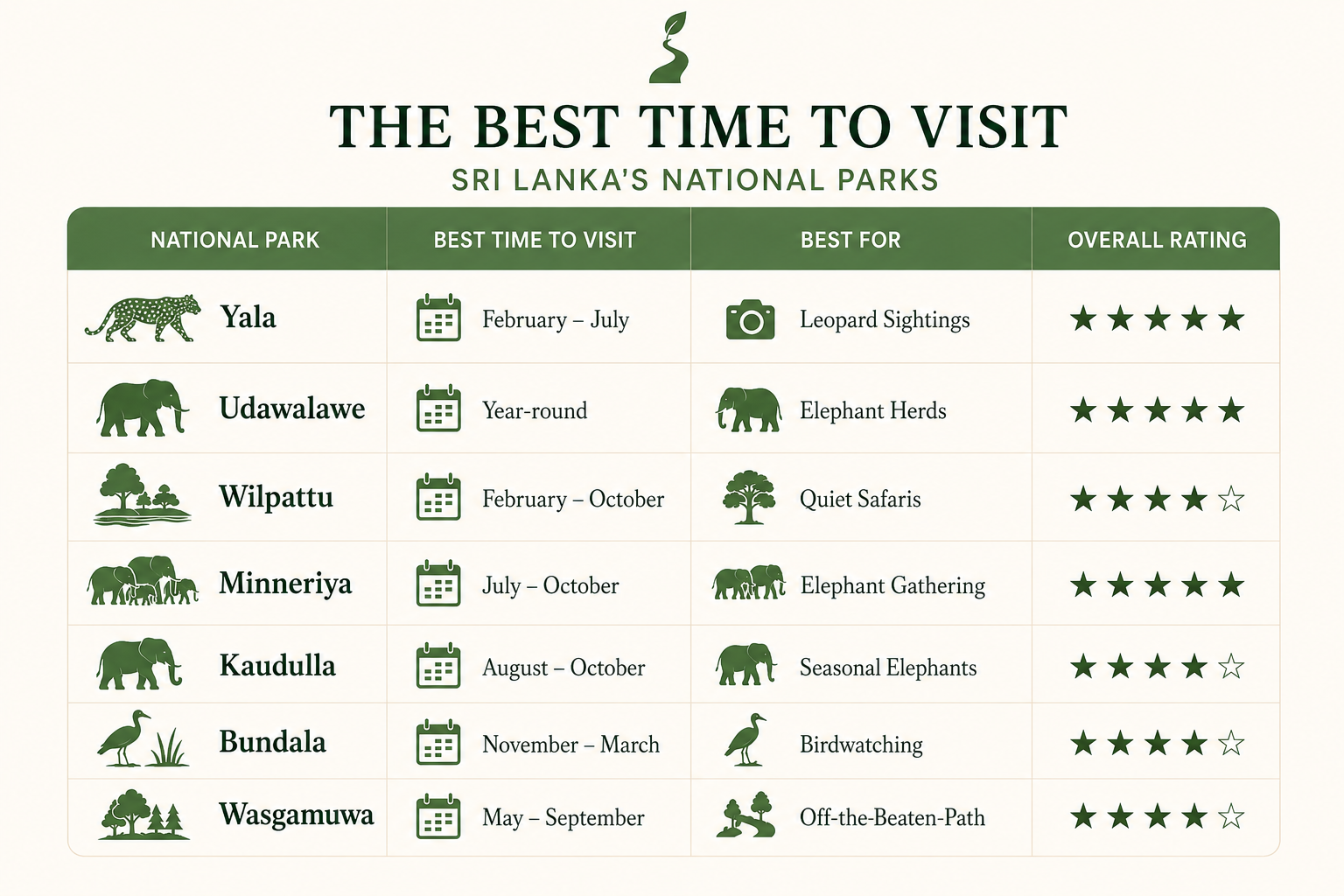
It's worth remembering that wildlife doesn't follow calendars. A leopard doesn't know it's July, and elephants certainly don't check weather forecasts. These periods simply offer the highest probability of memorable sightings based on seasonal conditions.
Morning, afternoon or full-day safari?
One of the first decisions you'll need to make is whether to book a morning safari, an afternoon safari or a full-day experience. On paper, they may seem fairly similar. In reality, each offers a completely different atmosphere.
Morning safaris
For most travellers, a morning safari is the best choice. Before sunrise, the air is noticeably cooler and wildlife is generally more active. Predators are still moving through the landscape after the night, elephants often feed in open areas before the day heats up and many bird species are at their busiest. The light is another major advantage. Photographers love the soft golden tones that appear shortly after sunrise. Dust hanging in the air catches the morning light beautifully, creating images that are almost impossible to recreate later in the day. Starting early also means you'll often experience the park before temperatures rise and before some of the later vehicles arrive. If you're only planning one safari during your trip, we'd almost always recommend choosing the first departure of the day.
Afternoon safaris
An afternoon safari offers a very different rhythm. The first hour can sometimes feel quiet, particularly if temperatures remain high. Many animals spend the hottest part of the day resting in shaded areas, making sightings less frequent. As the afternoon progresses, however, the park slowly comes back to life. Elephants emerge from the forest to drink, deer begin grazing in open grasslands and birds become increasingly active as the sun drops lower in the sky. The final hour before sunset is often spectacular. Warm golden light spreads across the landscape, creating beautiful conditions for photography and making even familiar scenery feel dramatic. If you're staying close to the park and enjoy slower-paced wildlife viewing, an afternoon safari can be incredibly rewarding.
Full-day safaris
For serious wildlife enthusiasts, nothing compares to a full-day safari. Instead of rushing through the park in three or four hours, you'll spend an entire day exploring different habitats while wildlife behaviour changes naturally around you. Leopards that remain hidden in the morning may appear during the afternoon. Elephants move between feeding areas. Bird activity changes throughout the day. The longer you stay, the more opportunities nature has to surprise you. Full-day safaris are particularly worthwhile in Yala and Wilpattu, where patience often leads to the most memorable wildlife encounters. They do require more energy—expect an early start, several hours in the jeep and plenty of sun—but for photographers and wildlife lovers, they're often worth every minute.
How much does a safari cost?
Compare the total safari price, not just the advertised jeep rate. Ask whether the quote is per person or per vehicle and confirm the following in writing:
Park admission, taxes and any required park staff.
Jeep hire, sharing arrangements and drive length.
Pickup location, transfer distance and extra charges.
Meals, water and permitted meal stops for a longer drive.
Cancellation terms and what happens if the park or a block closes.
Fees and packages change. Check the current tariff through the Department of Wildlife Conservation or ask your operator for an itemised quote. Choose responsible driving and clear inclusions alongside price.
Should you book in advance?
The answer depends on when you're travelling. Outside the busiest holiday periods, many safaris can still be arranged locally with relatively little notice. However, during Christmas, New Year, Easter and the European summer holidays, popular parks such as Yala and Udawalawe become much busier. Waiting until the last minute may leave you with fewer options or less experienced guides. If you already know your travel dates, we recommend booking your safari a few weeks before arrival. This doesn't just secure your place—it also gives you more choice when selecting departure times and operators. Many travellers prefer to book accommodation first and then reserve a safari through the same hotel. This can be convenient, but it's still worth comparing prices and reviews beforehand.
Where to stay near Sri Lanka's National Parks
One of the easiest safari-planning mistakes to make is booking accommodation that looks close to the national park on a map but is actually an hour away from the entrance.That extra travel time matters more than you might think. Morning safaris usually begin before sunrise, meaning every additional kilometre requires an even earlier wake-up call. Instead, we recommend staying as close to the park entrance as possible. You'll spend less time driving, enjoy a more relaxed morning and have a better chance of entering the park before it becomes busy. Whether you're looking for a luxury safari lodge, an eco-retreat surrounded by nature or a comfortable hotel with great value for money, these are our favourite places to stay.
Yala National Park
Uga Chena Huts
For travellers looking for a once-in-a-lifetime safari experience, Uga Chena Huts is one of the finest luxury lodges in Sri Lanka. Spacious private cabins are hidden among the dunes and jungle, just minutes from Yala National Park. Between safari drives you can relax in your private plunge pool, enjoy exceptional Sri Lankan cuisine and fall asleep to the sounds of nature.
👉Check availability & prices at Uga Chena Huts
Cinnamon Wild Yala
Cinnamon Wild Yala offers one of the best locations near the park entrance. Wildlife regularly wanders through the grounds, giving guests the feeling of staying inside the national park itself. Comfortable chalets, excellent dining and experienced safari partners make it one of the most popular choices for first-time visitors.
👉 Check availability & prices at Cinnamon Wild Yala
Ekho Safari Tissa
Located in nearby Tissamaharama, EKHO Safari combines comfortable rooms with beautiful lake views and excellent value for money. It's an ideal base for travellers wanting easy access to Yala while enjoying restaurants and facilities in town.
👉Check availability & prices at EKHO Safari Tissa
Udawalawe National Park
Kalu's Hideaway
Kalu's Hideaway is widely regarded as one of the best places to stay near Udawalawe. Surrounded by tropical gardens, the boutique hotel combines elegant rooms, outstanding hospitality and delicious food with easy access to the park entrance. Many guests arrange their safari directly through the hotel.
👉 Check availability & prices at Kalu's Hideaway
Grand Udawalawe Safari Resort
Just a few minutes from the national park, Grand Udawalawe Safari Resort is perfect for families and couples looking for spacious rooms, a large swimming pool and reliable service. After an early morning safari there's no better place to relax.
👉Check availability & prices at Grand Udawalawe Safari Resort
Athgira River Camp
If you're looking for something different, Athgira River Camp offers luxury safari tents overlooking the river. It combines the atmosphere of camping with the comfort of a boutique hotel and is an excellent choice for nature lovers.
👉 Check availability & prices at Athgira River Camp
Wilpattu National Park
Leopard Trails Wilpattu
For an unforgettable luxury safari, Leopard Trails offers beautifully furnished tented accommodation in a stunning natural setting. Gourmet dining, expert naturalists and small-scale hospitality create one of Sri Lanka's finest wildlife experiences.
👉 Check availability & prices at Leopard Trails Wilpattu
The Backwaters Lodge
Offering comfortable rooms and warm Sri Lankan hospitality, The Backwaters Lodge is an affordable base for exploring Wilpattu. The peaceful setting and friendly owners make it particularly popular among independent travellers.
👉 Check availability & prices at The Backwaters Lodge
Minneriya National Park
Jetwing Lake
Jetwing Lake combines modern luxury with spectacular views over the surrounding countryside. Located near Dambulla, it's perfectly positioned for safaris in both Minneriya and Kaudulla while also providing easy access to Sigiriya and the Cultural Triangle.
👉 Check availability & prices at Jetwing Lake
Aliya Resort & Spa
One of our favourite luxury resorts in the Cultural Triangle, Aliya Resort features beautiful infinity pools, spacious rooms and stunning views towards Sigiriya Rock. It's an ideal choice for travellers combining a safari with sightseeing.
👉 Check availability & prices at Aliya Resort & Spa
Habarana Village by Cinnamon
Set beside a peaceful lake, Habarana Village offers charming cottages surrounded by tropical gardens. The location makes it easy to reach Minneriya, Kaudulla and Hurulu Eco Park.
👉 Check availability & prices at Habarana Village by Cinnamon
What should you wear on safari?
Unlike a hiking trip in the mountains, preparing for a safari doesn't require specialised equipment. Comfort is far more important than fashion. Lightweight clothing in neutral colours works best. Beige, green, brown and grey help you blend into the surroundings, while bright colours can sometimes attract unnecessary attention. Mornings can feel surprisingly cool, especially when the jeep is moving, so bringing a light jacket is usually a good idea. By late morning, however, temperatures often climb quickly, making breathable fabrics much more comfortable. Closed shoes are preferable to sandals, particularly during the early hours when grass may still be wet. Don't forget sun protection. Even on cloudy days, several hours in an open jeep can quickly lead to sunburn.
What should you pack?
Fortunately, you don't need much. A camera with a zoom lens will always be useful, although modern smartphones now perform remarkably well for many wildlife photographs. If you have binoculars, bring them. They make a huge difference, especially for spotting birds and more distant animals. A reusable water bottle, sunscreen, sunglasses and insect repellent should also be on your packing list. Most importantly, bring patience. Nature unfolds at its own pace, and some of the best wildlife encounters happen when you least expect them.
A few common safari mistakes are surprisingly easy to avoid
Several safari-planning mistakes come up again and again, especially among first-time visitors.
The first is focusing entirely on leopards. Of course they're incredible animals, but spending your whole safari waiting for one means you may overlook elephants interacting with their calves, colourful birdlife or crocodiles basking in the morning sun.
The second mistake is booking the cheapest safari available. A poor guide can rush through the park, ignore interesting wildlife and spend the day chasing radio reports instead of reading the landscape.
Third, many visitors underestimate how early morning safaris begin. If your accommodation is too far from the entrance, you'll lose valuable sleep and may arrive after the best wildlife activity has already passed.
Another common mistake is expecting wildlife sightings to be guaranteed. Safaris are exciting precisely because nothing is staged. Every animal you see is there because it chose to be, not because someone placed it there for visitors.
Finally, don't spend the entire safari looking through a camera screen. Take photographs, certainly—but also take time to simply watch. The memory of hearing elephants quietly communicating across an open plain often lasts far longer than any photograph.
Can you do a safari with children?
A safari can be rewarding for children who enjoy wildlife, but consider an early start, heat, limited toilet stops and bumpy tracks. A shorter drive may suit your family better than a full day.
Ask the operator about seating, restraints, age policies, breaks and the actual pickup time. Bring water, snacks and sun protection, and keep children seated inside the vehicle. Wildlife sightings are never guaranteed, so make birds, smaller animals and the landscape part of the experience too.
Use our Sri Lanka with kids guide to fit the safari into a route with enough rest time.
Suggested safari itineraries
One of the advantages of travelling in Sri Lanka is that the country's compact size makes it easy to include one or more safaris without significantly changing your route. Here are some of the safari combinations that work particularly well within a Sri Lanka itinerary.
7-day Sri Lanka itinerary
With only one week available, we'd keep things simple. After exploring the Cultural Triangle or the southern coast, include a single safari in Udawalawe National Park before continuing your journey. The park's reliable elephant sightings make it an excellent introduction to Sri Lanka's wildlife, and it fits naturally into many popular travel routes.
—> Explore our complete 7 day Sri Lanka itinerary
14-day Sri Lanka itinerary
Two weeks is, in our opinion, the perfect amount of time to explore Sri Lanka. A classic route might look something like this: Colombo → Sigiriya → Minneriya → Kandy → Ella → Udawalawe → Yala or the south coast → Galle → Colombo. This itinerary combines history, culture, tea plantations, wildlife and beaches without feeling rushed. If you're travelling during the Elephant Gathering season, replacing Udawalawe with Minneriya is another excellent option.
—> Explore our complete 14 day Sri Lanka itinerary
3 week Sri Lanka itinerary
With three weeks in Sri Lanka, you have enough time to experience two very different safari regions without rushing the rest of your trip. Start with Wilpattu National Park in the north, where quieter safari tracks, dense forest and natural lakes create a more remote wilderness experience. Later in the journey, visit Yala National Park in the south for a completely different landscape and another chance to spot elephants, crocodiles, birdlife and, if you're lucky, a leopard. Combining Wilpattu and Yala gives you a much broader experience of Sri Lanka's wildlife while still leaving plenty of time for the Cultural Triangle, hill country, east coast and southern beaches.
Frequently Asked Questions
-
Without question.
While it doesn't offer the huge mammals of East Africa, Sri Lanka provides one of the most diverse wildlife experiences in Asia. The opportunity to combine safaris with beaches, cultural sites and mountain scenery makes it unique.
-
Yala National Park remains the strongest choice, although Wilpattu is an excellent alternative for travellers seeking a quieter experience. Remember that no sighting is ever guaranteed. That's part of what makes seeing a leopard so special.
-
Udawalawe consistently provides some of the most reliable elephant sightings in Sri Lanka. If you're travelling between July and October, Minneriya's Elephant Gathering is another unforgettable option.
-
Yes.
Safaris can be a fantastic experience for families travelling with children. A half-day safari in Udawalawe often provides a good balance between exciting wildlife encounters and manageable driving times.
-
Often, yes.
Outside the busiest travel periods, many hotels can arrange safaris with local operators. However, if you're visiting during Christmas, Easter or the European summer holidays, booking ahead gives you a much wider choice of guides and departure times.
-
Compared with many safari destinations around the world, Sri Lanka offers excellent value. Whether you're travelling on a backpacker's budget or staying in luxury safari lodges, there are options to suit almost every traveller.
-
If you only have time for one safari, we'd choose Udawalawe for most first-time visitors.
While Yala may receive more international attention, Udawalawe consistently delivers outstanding wildlife encounters, especially for first-time visitors. Seeing elephants in the wild is something you'll never forget.
-
There isn't one simple answer. Different parks perform best at different times of the year because Sri Lanka experiences two monsoon seasons.
Rather than choosing a fixed park months in advance, it's often smarter to choose the park that offers the best wildlife conditions during your travel dates.
Continue planning your Sri Lanka safari
Ready to choose your national park? Explore our detailed safari guides:
Yala National Park Guide — Leopards, elephants and Sri Lanka's most famous safari experience.
Udawalawe National Park Guide — One of the best choices for seeing elephants.
Wilpattu National Park Guide — A quieter safari through forests and natural lakes.
Minneriya National Park Guide — Famous for spectacular elephant gatherings..
Before you go
If this guide helped you plan your Sri Lanka safari, be sure to save it for later or share it with your travel companions. And remember—some of the best safari moments aren't the ones you expect. They're the quiet ones, when the engine is off, the jungle is still and nature reveals itself on its own terms. That's the Sri Lanka you'll remember long after your journey has ended.
More Sri Lanka inspiration